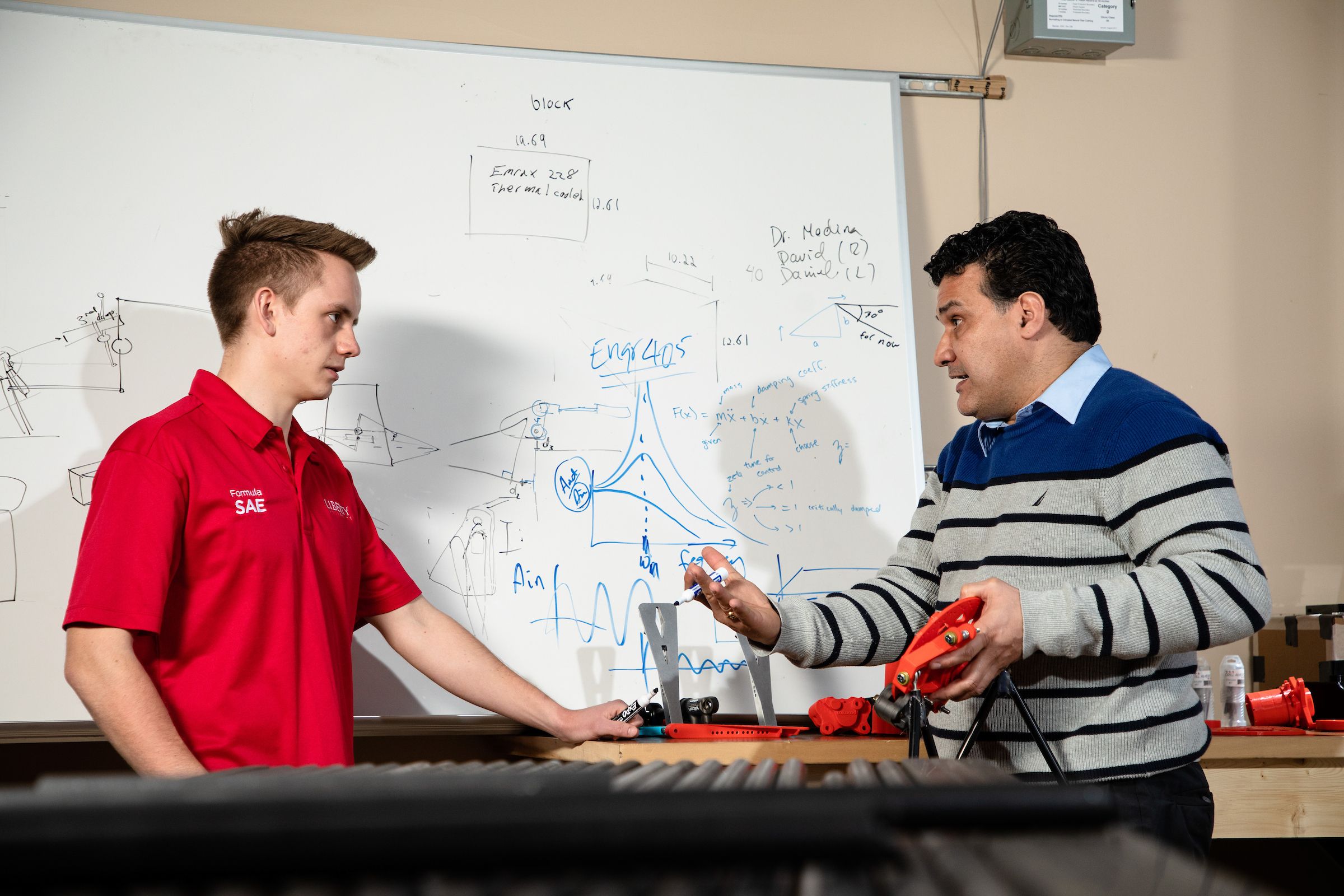
Bachelor of Science in Physics
Explore the Universe as an Undergraduate Physics Major
Have you ever wondered how the universe works – from the motion of planets to the behavior of subatomic particles? A Bachelor of Science (BS) in Physics can allow you to explore these questions while developing analytical and problem-solving skills that apply to many fields in science and technology.
Physics majors examine the laws that govern motion, energy, matter, and space. Through Liberty University’s physics program, you can study foundational scientific principles while strengthening your mathematical reasoning and scientific investigation skills. These abilities are valued in research, technology, engineering, and data analysis roles.
At Liberty, you can also explore physics through a biblical worldview. As you examine the structure and order of the natural world, you can consider how scientific discovery relates to faith and the belief that the universe reflects intentional design.
Credit Hours
View CoursesNext start date: Jan 18, 2027

Liberty University is accredited by SACSCOC
Highlights
Highlights of Our Bachelor’s in Physics Degree
Prepare for Diverse STEM Pathways
Our Bachelor of Science in Physics degree emphasizes analytical thinking, mathematical modeling, and scientific investigation. These skills are widely valued in STEM fields and can support future study or careers in research, engineering, technology, or data analysis.
Access Career Development Resources
You can take advantage of Liberty University’s Career Center as you explore potential career paths. Through available resources, you can receive guidance on résumé development, interview preparation, and job search strategies.
Connect Scientific Discovery with a Christian Worldview
As a student in the physics undergraduate program, you can study within Liberty’s College of Arts and Sciences under faculty who emphasize both academic excellence and thoughtful scientific inquiry. Our professors encourage discussion of how scientific discovery connects with philosophical and theological questions, helping you explore physics from a biblical worldview.
Study the Foundations of Modern Physics
Your physics courses will introduce major branches of physics, including mechanics, thermodynamics, electricity and magnetism, optics, and quantum physics. As you study these areas, you can strengthen your ability to analyze complex physical systems using mathematical and scientific reasoning.
Career Potential
What Can You Do with a BS in Physics Degree?
Liberty University’s Bachelor of Science in Physics can help prepare you to pursue the following occupations:
- Data analyst
- High school physics teacher*
- Physicist in industry or government laboratories
- Research scientist
- Technology analyst
*May require licensure

Among the Top 5 College Campuses in America
At Liberty, you’ll find an affordable, high-quality education designed to help equip students like you for the real world. Our commitment to excellence has earned us recognition as one of the Top 5 College Campuses in America by Niche.com for 2027.
Earning your degree from a nonprofit university with state-of-the-art resources like ours can help set you apart from your peers.
Courses
What Will You Study in Our Physics Bachelor’s Degree?
Our physics bachelor’s degree combines advanced mathematics with scientific theory and experimentation. Throughout this program, you will study core physics concepts while building the mathematical tools used to analyze and interpret them in real-world contexts.
Your studies will include foundational courses in calculus and university physics, along with advanced topics such as mechanics, electricity and magnetism, thermodynamics, optics, and quantum physics. As you explore these areas, you will examine how physical laws describe the behavior of matter and energy, from subatomic particles to large-scale systems.
Mathematics plays a central role in the bachelor’s in physics curriculum. Courses in applied linear algebra and differential equations can help you model physical systems, solve complex problems, and interpret experimental results. You will also engage with computational and analytical methods used in modern physics.
As you advance through the program, you can practice scientific investigation by analyzing data, evaluating theoretical models, and communicating technical information clearly. Your program will conclude with a physics capstone project, where you can investigate a research topic, analyze data, and present scientific findings.
Featured Physics Courses
PHYS 305 – Introduction to Modern Physics
PHYS 321 – Mechanics
PHYS 432 – Thermodynamics and Statistical Mechanics
PHYS 440 – Wave Optics
Degree Information
- This program falls under the College of Arts and Sciences
- View the Degree Completion Plan (coming soon)
- Check out our course catalog
- Transfer in up to 75% of the degree total
BENEFITS
Why Choose Liberty’s Bachelor’s in Physics Program?
Access Modern Science Facilities
As you pursue your BS Physics at Liberty, you can take advantage of state-of-the-art science facilities designed to bring classroom concepts to life. These modern learning environments provide dedicated laboratory space where you can explore physical principles through hands-on experimentation and observation – giving you the practical, real-world experience.
Experience a Vibrant Residential Campus
While completing your bachelor’s in physics, you can participate in Liberty’s dynamic residential community. Student organizations, research opportunities, campus events, and mentorship programs can help you grow academically, socially, and spiritually throughout your college experience.
Study Physics Through a Biblical Worldview
As a physics major at Liberty, you can explore scientific discovery alongside faith. As you study the laws that govern nature, you can reflect on how scientific inquiry and belief in a designed universe intersect.
Learn from Faculty Who Invest in You
You can study under professors who bring industry experience and a commitment to mentorship. As you progress through your program, you can engage with faculty who support your academic growth and development.
Admissions
How Do You Become a Student in the Physics Bachelor’s Program?
Every application is reviewed by the admission committee on a case-by-case basis, meaning there are no set minimums for acceptance. However, all applicants must submit the following documents* for admission:
- Admission application
- Official high school transcripts
- Official college transcripts (if applicable)
- Champion Story
Results from the CLT, SAT, or ACT are not required for admission, but may be used in consideration for merit-based aid.
*Note that additional documentation may be requested by the admission committee after your application has been received.

Have Questions?
We’ll make sure you have the information you need to take your next step.