
Beyond Barriers Summer Transition Program 2026
ACCEPTING APPLICATIONS NOW! Incoming freshmen and transfer students with documented disabilities are invited to participate in an immersive 10-day orientation program designed to help them make a smooth transition to Liberty University.
- Early move-in
- Dine in the dining hall
- Complete UNIV 101 (1-credit course)
- Connect with fellow students in a variety of engaging activities
Program sessions include introductions to key services and departments across the university, group outings to get familiar with the campus, and interactive training to improve self-regulation and self-determination.
CLICK HERE FOR DETAILS AND APPLICATION!
Welcome to ODAS!
Liberty University’s Office of Disability Accommodation Support (ODAS) exists to ensure equal access and an inclusive campus free from barriers to the educational experience by providing individualized advising, advocacy, and reasonable accommodations to support students with disabilities and temporary medical conditions.

LU Accommodate is our accommodation tool that streamlines the review, approval, and delivery of accommodations. With LU Accommodate, students with documented disabilities can manage their accommodation requests, appointments, and related services with ease.
If this is your first time setting up an LU Accommodate account with ODAS (as an incoming or current student), please use the link to the right and have your disability documentation ready to upload. Examples of acceptable documentation include the following:
- psychoeducational evaluation
- copy of the student’s high school IEP or 504 plan – must include a diagnosis
- letter, on letterhead with signature, from an appropriate licensed healthcare provider who has personally assessed or treated the student and identifies a disability. (Documentation cannot be provided by a family member.)
Accommodations Already In Place?
If your accommodations have already been approved, please use the link below to log in to your LU Accommodate account. This account will be used to:
- Request your semester/term accommodations
- Keep current with ODAS announcements
- Schedule appointments with your ODAS advisor
- Access the LU Accommodate Resource Library
Academic Accommodations
Students are responsible to disclose their disability to ODAS (where all disability information is kept strictly confidential) for the purpose of receiving accommodations. If they do not do so, professors and others are not obligated to accommodate a disability. Once a student’s Initial Accommodation Request and disability documentation have been reviewed, he or she will be contacted by a Disability Advisor to schedule an intake meeting to discuss accommodations and helpful campus resources. Accommodation letters are then sent to the student and his or her faculty for that particular semester or sub-term. Students are encouraged to follow up with faculty regarding details of their accommodation letters (i.e. modified attendance or a make-up test) and self-advocate as needed.
*NOTE: Students must submit a Semester/Term Request through LU Accommodate for each semester and sub-term that they need their academic accommodations.
Non-Academic Accommodations – Housing, Dietary, and Support Animals
As with academic accommodations, students are responsible for disclosing their disability to ODAS for reasonable non-academic accommodations to be determined. Students may include non-academic accommodations requests when submitting an Initial Accommodation Request or separately by submitting a “supplemental request” in LU Accommodate. When submitting a request for non-academic accommodations, a student must attach a Disability Verification Form that has been completed by their licensed healthcare provider.
An Accessibility Advisor will contact the student to schedule an intake meeting to discuss non-academic accommodations as a separate process from academic accommodations. ODAS will determine what accommodations are reasonable for the student to have equal access through conversations with the student about the functional limitations resulting from a student’s condition. ODAS will then contact Residence Life Housing (for housing and service animal accommodations) and the Campus Dietitian (for dining accommodations) to determine what accommodations are possible and available.
LU Service & Emotional Support Animal Policy
Non-Academic Accommodation FAQs
Additional Accommodations
- Alternate Textbook Services
- Deaf/Hard of Hearing Services
- Deaf and Hard of Hearing Service Request Form (LU faculty and students’ campus events)
For Liberty University Interpreting Services, please visit the LUIS website.
Click Here to Report a Barrier Around Campus
Liberty University is committed to equal access and the civil rights of people with disabilities. Barriers to this access may include things such as
- an inoperative elevator
- a blocked access ramp
- an inaccessible website
- video without captions
- other lack of access to an event or program
Resources
- Beyond Barriers Summer Transition Program
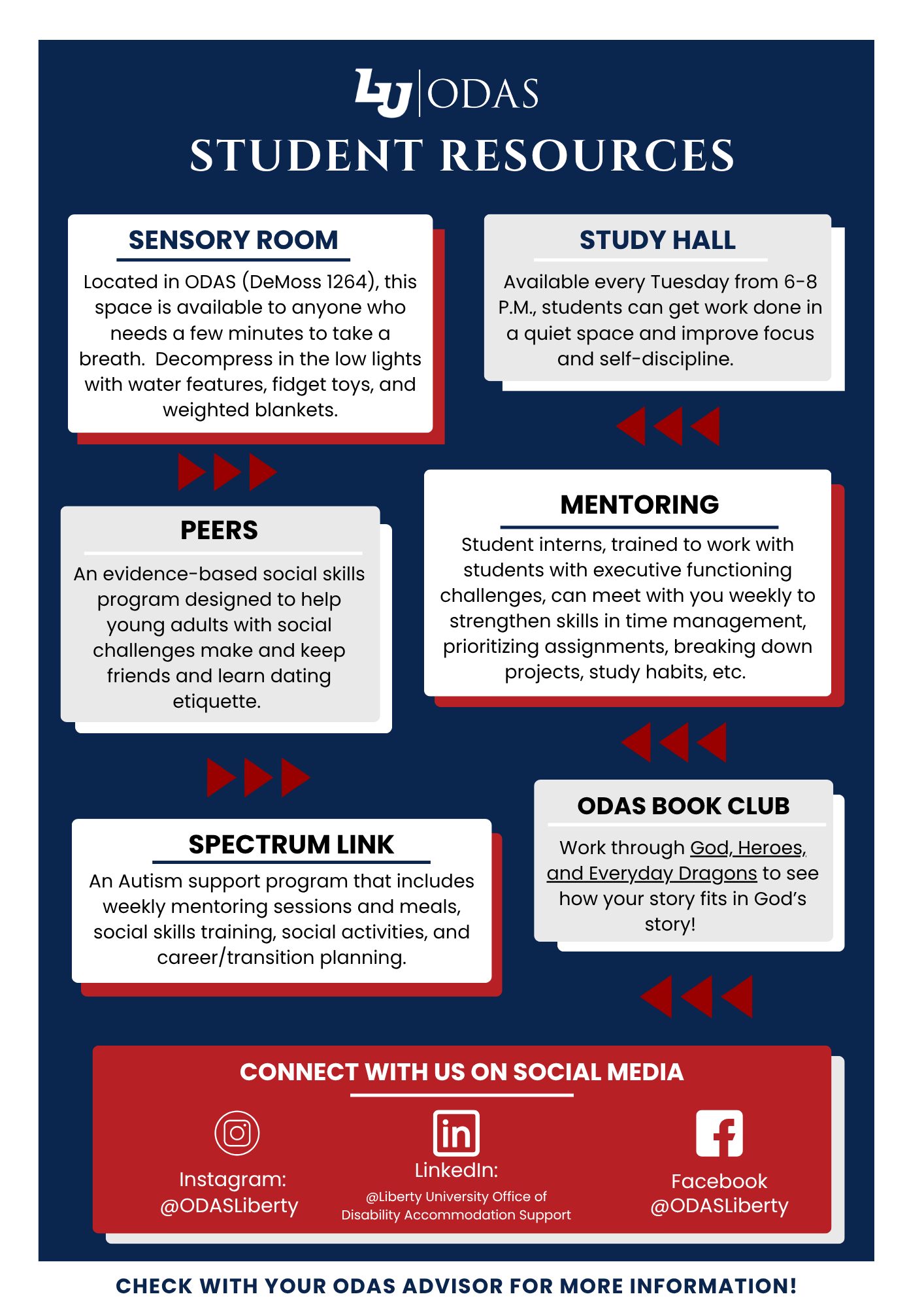
- LU ODAS Resources
- Spectrum LINK Autism Support Program (info to come)
- Scholarship Resources
Institutional Responsibilities
Section 504 of the Rehabilitation Act of 1973 prohibits discrimination on the basis of disability against students in institutions of higher education. Section 504 mandates “reasonable” accommodations to provide equal program access to all students with disabilities. Faculty are responsible for implementing reasonable accommodations for students with disabilities as approved through the University’s disability services process.
The university has an obligation to make reasonable accommodations in policies, practices or procedures when needed to prevent discrimination on the basis of disability unless making such accommodations would fundamentally alter the nature of the service, program or activity, or would result in undue financial and administrative burdens.
We realize that individuals with temporarily disabling conditions resulting from injuries, surgery, or complications in pregnancy may need access to accommodations similar to individuals with permanent disabilities. Examples of temporary disabilities may include but are not limited to concussions, injuries, or short-term impairments following surgery or medical treatments.
A disability is a physical or mental impairment that substantially limits one or more of the major life activities of the individual.
-
- Major Life Activities:
The phrase major life activities refers to normal functions such as caring for one’s self, performing manual tasks, walking, seeing, hearing, speaking, breathing, learning, and working. - Physical Impairment:
A physical impairment includes any physiological disorder or condition, cosmetic disfigurement, or anatomical loss affecting one or more of the following body systems: neurological, musculoskeletal, special sense organs, respiratory and speech organs, cardiovascular, reproductive, digestive, genitourinary, hemic and lymphatic, skin and endocrine. - Mental Impairment:
A mental impairment includes any mental or psychological disorder such as organic brain syndrome, emotional or mental illness, and specific learning disabilities. - Learning Disability:
A learning disability is a generic term that refers to a heterogeneous group of disorders manifested by significant difficulties in the acquisition and use of listening, speaking, reading, writing, reasoning, or mathematical abilities. These disorders occur in persons of average to very superior intelligence and are presumed to be due to central nervous system dysfunction.
- Major Life Activities:
Specific disabilities include, but are not limited to, the following: blindness or visual impairment; chronic illnesses; psychiatric and emotional disabilities (ADHD, anxiety and related disorders, depression, etc.); deafness or hearing impairments; epilepsy or seizure disorders; orthopedic impairment; specific learning disability; speech disorder; spinal cord or traumatic brain injury; and neurological and neuromuscular disorders.
Students with documented disabilities may be eligible for some of the following services:
-
- Extended time for testing
- Testing in a quiet environment
- Priority pre-registration
- One-on-one accommodation advising
- ASL Interpreters
- Osborne Assistive Learning Technology Center:
- JAWS for Windows: screen reading software for the visually impaired
- Kurzweil 3000: scanning and reading software for students with reading disabilities
- Dragon Naturally Speaking: speech recognition software which can turn speech into print
- CCTV: magnification hardware for the visually impaired