Engineering seniors develop innovative industry solutions through Capstone projects
May 13, 2026 : By Ted Allen - Office of Communications & Public Engagement


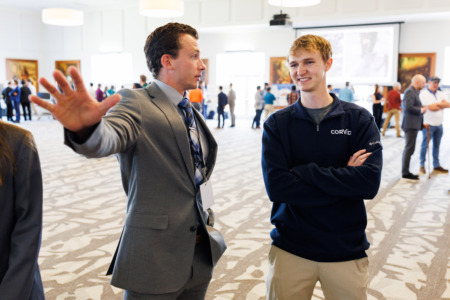
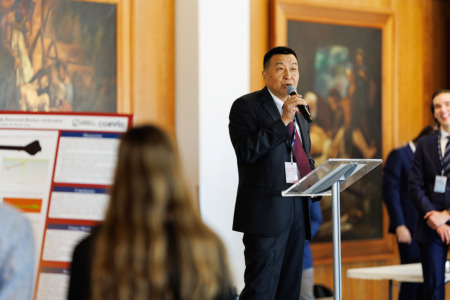
Graduating students in Liberty University’s School of Engineering showcased the results of their teams’ collaborative research and development during Friday’s annual Engineering Capstone Expo at the Montview Student Union, Alumni Ballroom.
Capstone Senior Design Projects develop partnerships between students and internal clients and/or area companies, such as local engineering firms Framatome and FTS. Students engage in industry design challenges, working toward solutions while building résumés. The program often opens a window of opportunity to launch their careers with the partner companies.
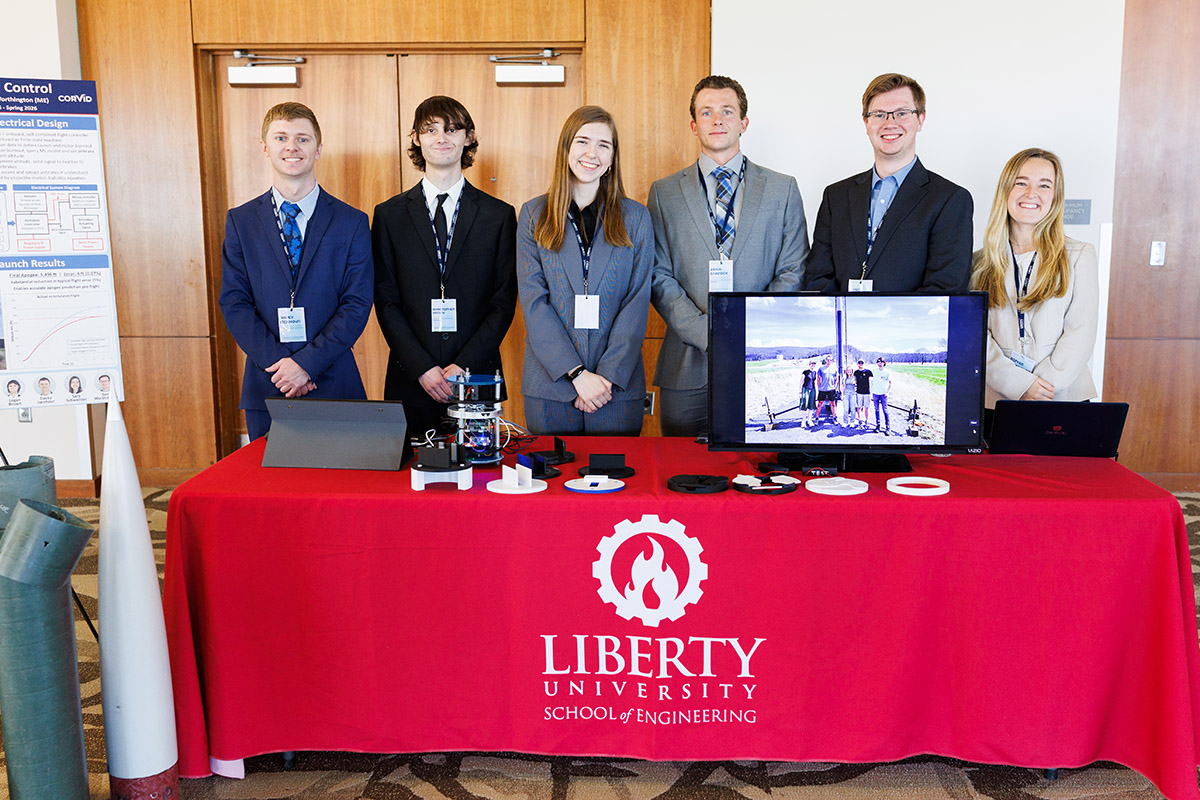
Capstone teams involved students from all five engineering programs: mechanical, electrical, computer, industrial & systems, and civil. Awards were presented to the top projects in three categories (see list of winners below).
There are typically four to six students per team, each spending an average of 250-300 hours on the project over their final two semesters.
A handful of projects on display at this year’s expo were designed to benefit the School of Engineering’s own competition teams, including Liberty Rocketry and the Liberty Motorsports Baja SAE vehicle team.
Working with Dr. Howie Fang, chair of the mechanical engineering department who oversees the Capstone program, a group partnered with Corvid Technologies to build a module that can be fired aboard future rockets using machine learning-based airbrakes to control the apogee (or apex of the trajectory) much closer to the targeted elevation.
The group performed a subscale test launch in cooperation with the Liberty Rocketry team last month, and it peaked at 5,004 feet.
“This is the first time that any rocket competition team at Liberty has done active instead of passive control on a rocket and it was tremendously successful. It performed phenomenally,” said Simon Babcock, who headed the team and will join Corvid’s advanced weapons system group based in Mooresville, N.C., after graduating this weekend. “We were .07 percent off, 4 feet off, of our target apogee, making it the second most-accurate launch ever recorded for any collegiate competition team in the world.”
The six team members included three from mechanical engineering (Babcock, Sophie Batchelor, and Samuel Worthington), two from computer engineering (Christopher Brown and Davey Isenhour), and one student from the electrical program (Sara Schweitzer).
Corvid financially sponsored the project while leading and guiding some of the methodology, specifically the computational fluid dynamics (CFD) analysis, and gaining information from the machine learning model application.
The final system will be delivered to the Liberty Rocketry competition team for consideration to incorporate into next year’s model that it will enter into the International Rocket Engineering Competition in Texas next summer.
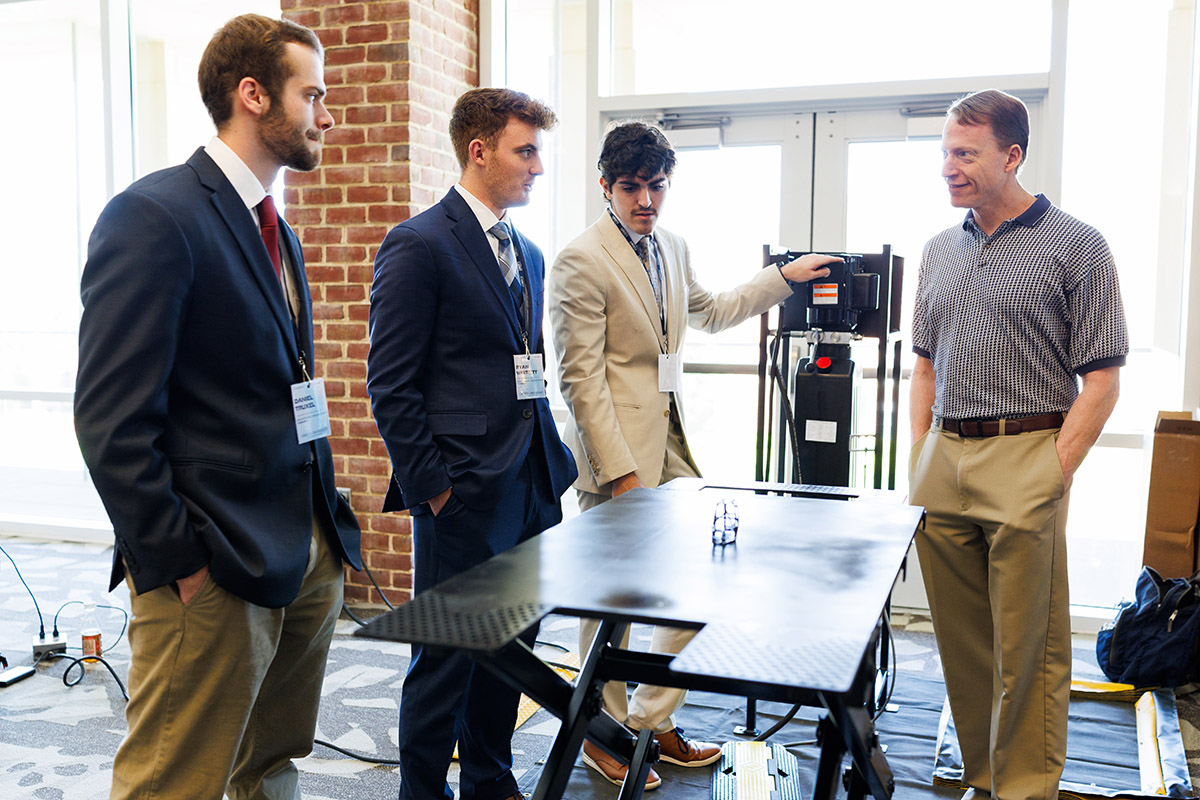
Another award-winning team composed of four mechanical engineering students who also serve in various capacities on the Baja SAE competition team built a hydraulic powered lift with scissor geometry designed to elevate to a maximum height of 4 feet. Equipped with a mechanical height lock to prevent sudden hydraulic failure, it will allow Baja SAE team members to safely raise their vehicles to more ergonomic positions during the manufacturing and assembly process and when performing regular maintenance.
Caleb Kortens, an electrical engineering student, served as team lead for a multidisciplinary project involving mechanical and electrical engineering students who worked alongside the civil engineering steel bridge construction team to study bridge vibration testing setup for load identification.
He said the project stretched him, but it was beneficial in preparing him to be a part of a professional workforce.
“I’m not a natural leader, so it was a step out of my comfort zone,” Kortens said. “It was a hard project, but it was great for personal growth. I handled a lot of the admin stuff, making sure things were turned in, doing all of the communication with the client and the instructors.”
Kortens will begin his career as a substation engineer for Actalent in nearby Roanoke, Va.
A team of three mechanical engineers — including Liberty Motorsports Formula SAE competition team lead engineer Elijah Ometz — and two electrical engineers worked on developing a V-22 Osprey slip ring test fixture for NAVAIR. The device simulates the 370 revolutions per minute of the twin tiltrotors that can create heavy vibrations within the prop assembly on the military transport and cargo aircraft, resulting in fatigue damage and mechanical failure.
“It was difficult in some aspects because we didn’t have the actual dimensions of the slip ring,” said Jack Moore, a mechanical engineering student. “It’s a classified part. We weren’t able to take a slip ring because they’re like $80,000, so we had to make our own. When we actually spun the real slip ring at NAVAIR, it worked as intended.”
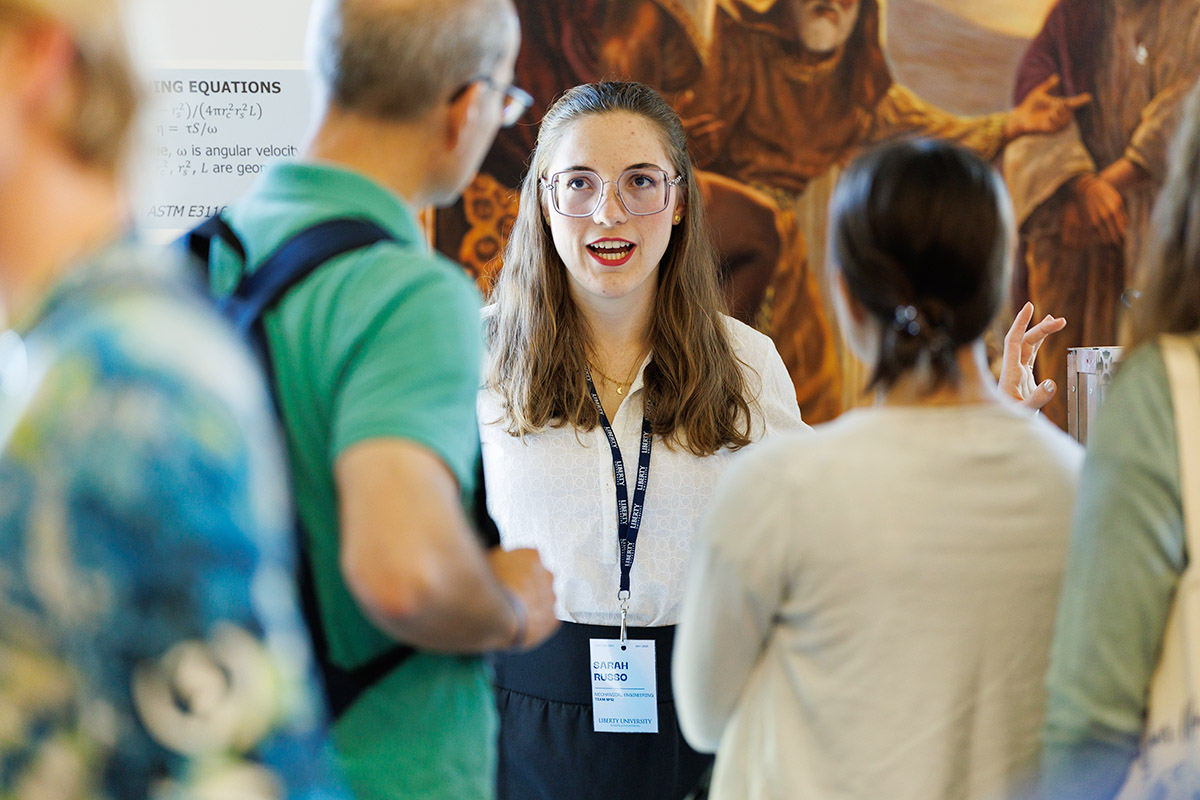
The device features a full electrical control system and is industry standard for this kind of equipment.
“We wanted to make it modular, so if the client were to send it out to Afghanistan or somewhere like that, they’d be able to disassemble and quickly reassemble it while maintaining functionality,” Moore said, noting the slip ring has a design life of 10,000 hours, but it has only been getting between 400-800 hours before needing to be disassembled and sent back to the manufacturer for costly inspections and repairs. “This piece of equipment will hopefully speed up the maintenance time that they’ve been dealing with.”
Moore also serves as co-lead of the brakes team for the Formula SAE car that will be competing with a support crew of 27 team members at this weekend’s collegiate nationals at Michigan International Speedway.
One team worked on a project for FTS in Forest, Va., called Quick Gage, a portable railroad battery-powered gauge spreader designed to latch onto rails and either expand or contract them to the 56.5-inch standard.

“They really loved the concept, and they were very happy with us and wonderful to work for,” said Nathan Bruckner, an electric engineering student who worked on the battery-powered impact driver actuator and supervised the milling and laser cutting required to manufacture circuit boards that operate the system.
Mechanical team lead Landin Robinson already co-owns three patents for electric rail tool attachments, including one sold by FTS around the world that effectively removes the stakes from rail lines.
Industrial & Systems Engineering seniors Isabella Selthun, Benaiah DeLeon, and Deborah Sinai worked on a Liberty University Traffic Simulation, using Simulation of Urban MObility (SUMO) software to develop solutions to improve traffic flow around campus. They collaborated with Rachel Luce, a planner with the Liberty University Emergency Management & Community Engagement, with ISE Professor Michael Zamperini serving as faculty advisor.
2026 Excellent Capstone Project Awards
Civil Engineering Teams
Project: Heavy Weight Transport Light Industrial Center Development
Sponsor: Cypress Engineering and Capstone Engineering & Land Solutions
Team Members: Connor Bradley, Carter Fath, Clayton Felice, Samantha Helder, Lydia Parker, Ethan Stansbury
Capstone Advisors: Hyunjoong Kim, Kalehiwot Manahiloh, Bryon Ringley, Songsu Son
Industrial & Systems Engineering Teams
Project: Textron TSV Scheduling and Batching
Sponsor: Textron TSV
Team Members: Connor Eberhart, Micah Riley, Camila Oliveira, Rebecca Hooper
Capstone Advisor: Dr. Felix Asare
Mechanical/Electrical/Computer Engineering Teams
Project: Quick Gauge Railroad Battery-Powered Gauge Spreader for Rail Expansion-Contraction
Sponsor: FTS Rail in Forest, Va.
Team Members: Nathan Bruckner, Luke Krick, Landin Robinson, Joshua Mack, Katie Breneman
Capstone Advisor: Dr. Billy Zhang
Project: Machine Learning-Based Airbrakes Control for Rocketry Apogee Targeting
Sponsor: Corvid Technologies LLC
Team Members: Simon Babcock, Sophie Batchelor, Christopher Brown, Davey Isenhour, Sara Schweitzer, Samuel Worthington.
Capstone Advisor: Dr. Howie Fang
Project: Hydraulic Baja Car Lift
Sponsor: LU Baja SAE Competition Team Coordinator Steve Mason
Team Members: Daniel Truxel, Ryan Whitsitt, Joel Tibbits, Danny Lazor
Capstone Advisor: Dr. Joby Anthony III; Faculty Mentor: Dr. Ephriam Zegeye
2026 Capstone Senior Design Project Sponsors
Corvid Technologies LLC
Cypress Engineering (2 projects)
Dominion Energy
Framatome Inc. (3 projects)
FTS
Kennametal
McKee Foods Corporation (2 projects)
NAVAIR (2 projects)
NovaTech
Solve Industrial Motion Group
Textron
Torch Technologies