Liberty School of Aeronautics leaders meet with U.S. Secretary of Transportation Sean Duffy
May 29, 2026 : By Ted Allen - Office of Communications & Public Engagement


Ensuring safety in the skies above Lynchburg and Central Virginia is of paramount importance for Liberty University School of Aeronautics administrators and staff, and it is high on the list of priorities across the country for U.S. Secretary of Transportation Sean Duffy.
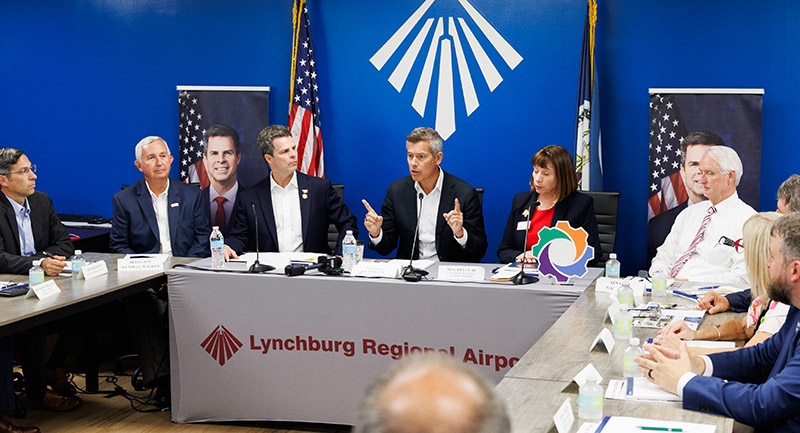
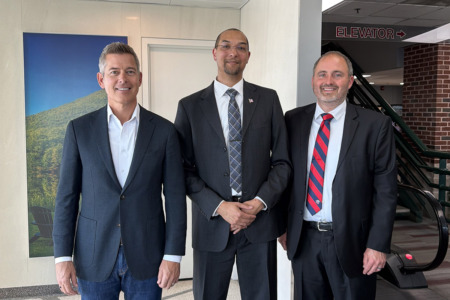
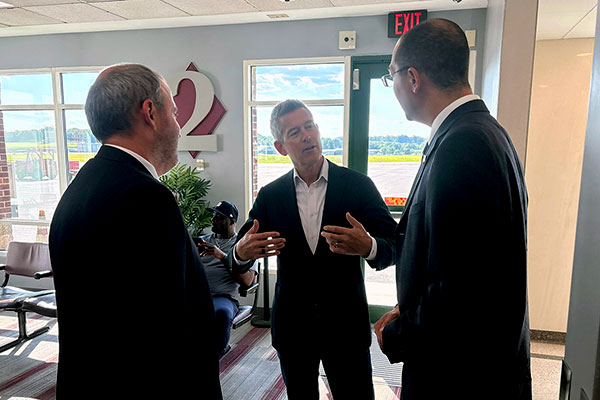
Less than two weeks after Scott Turner, the 19th Secretary of Housing and Urban Development, delivered the keynote address at Liberty’s 53rd Commencement Main Ceremony, Secretary Duffy toured Lynchburg Regional Airport with U.S. Rep. John McGuire (R-5th Congressional District), airport representatives, and School of Aeronautics Dean Dr. Steven Brinly on Thursday afternoon before participating in a roundtable discussion and press conference with local and regional leaders.
“We serve approximately 6,000 aeronautics students training in Lynchburg, across the country through the Flight Training Affiliate Program, and around the world to help meet the critical workforce needs, so we’re thankful for the support from the federal government and all of the locally elected officials here,” Brinly said, referring to Rep. McGuire, who invited Secretary Duffy to Lynchburg, along with Virginia Del. Wendall Walker (52nd District), Virginia Sen. Mark Peake (R-District 8), Lynchburg Mayor Larry Taylor, and others. Other Liberty leaders at the event were School of Aeronautics Director of Simulator Operations Dwight Williams and Liberty Director of Government and Community Relations Kenny Craig.
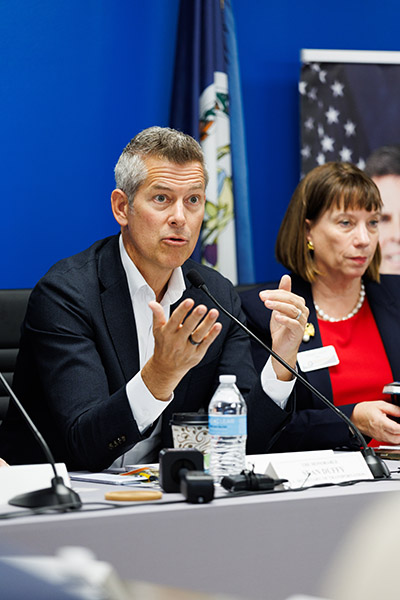
After Secretary Duffy’s introductory remarks, Lynchburg Regional Business Alliance CEO Megan Lucas, representing more than 900 businesses in the region, spoke highly of the impact Liberty University has on the community.
“We have three sectors that drive our economy: higher education, manufacturing, and agriculture,” Lucas said. “Liberty University is our economic engine. They are the tip of the iceberg for higher education.”
Secretary Duffy provided an overview of his department’s national emphases on road and bridge infrastructure repair and development, airport upgrades — including a recent $8 million FAA Airport Improvement Program (AIP) grant to facilitate entry and exit traffic to and from the terminal — and streamlining mass transit avenues. The roundtable discussion covered a variety of issues affecting area residents and businesses, including the Greater Lynchburg Transit Authority, and highlighted the spirit of cooperation between local, regional, state, and federal agencies.
One topic of discussion with implications for the School of Aeronautics was the federal government’s recent approval of a $12.5 billion investment into improving the technology used by air traffic controllers at airports nationwide. According to Duffy, the massive overhaul of antiquated systems is in the early stages and faces major hurdles. Duffy toured the airport’s air traffic control tower during his visit.
Williams said the introduction of drones into the airspace necessitates improvements.
“There is significant air traffic in the Lynchburg area, including (LUSOA) student flight training, commercial or corporate aircraft, and even unmanned aerial systems (drones) flying at any given time,” he explained further after the meeting. “Investing in those technologies and being able to reliably detect and mitigate threats like potential aircraft collisions as well as emerging threats, such as unidentified drones, makes the sky safer for everybody, especially for our student (pilots) here at Liberty.”
He said the challenge at hand is the number of airports in need of new technology.
“The large, international airports, such as Chicago O’Hare, Miami, and New York La Guardia, may be done first,” he said. “It’s smaller ones like Lynchburg (or) Lakeland (Fla.) that may not be at the head of the line to be modernized, but they will get done.”
Duffy said the massive overhaul in radio and air traffic control technology will enhance surveillance capability and replace existing copper wiring transmissions with fiber.
“We’re deploying all new radar and all new radios, which date back to the early 80s, (enabling) crisper communication,” he said.
According to a Department of Transportation press release, those upgrades are projected to be completed in Lynchburg by February 2027, along with new displays for controllers to improve situational awareness by next March and new radios for pilots to communicate more clearly by January 2028.
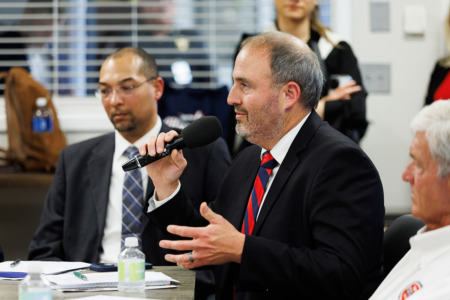
A federal modernization initiative having more immediate impact on School of Aeronautics operations is geared toward ensuring the training conducted at pilot schools meets the 21st century challenges of technology, safety, and the advancements in teaching and learning techniques.
“We are grateful for the federal government’s growing support of training programs through the Part 141 modernization,” Brinly said. “There is a clear emphasis from this administration on strengthening workforce pipelines for pilots, maintainers, and air traffic controllers, and it is encouraging to see that commitment taking shape. That investment will have a direct and lasting impact on our students, our alumni, and the future of the aviation workforce.”
He said recent FAA support has provided increased availability of Designated Pilot Examiners (DPE) and Designated Mechanic Examiners (DME) in Lynchburg.
“That helps our students and our community, so when they finish with their flight training or Aviation Maintenance Technician Program training to get that FAA certification,” Brinly said, noting other flight and maintenance schools are having to find those resources or send their students away to be certified. “So we’re thankful for the support of the federal government and especially our regional flight standards district office (FSDO) to make that a possibility.”
He said the FAA and other government agencies, including the Department of Transportation, have been very responsive to a variety of the university’s requests.
“We’ve been fortunate to have members of our team speak into the Part 141 modernization initiative,” Brinly said. “We haven’t seen the final rules, but we’re anticipating that it will bring benefits to our students and pilot training across the country.”
Brinly noted Secretary Duffy’s visit came just over three weeks after FAA Administrator Bryan Bedford addressed staff and students remotely during the final School of Aeronautics meeting on May 5.
“Having Bedford speak to our students was an incredible opportunity to hear directly from the leader of the federal agency that oversees our industry,” Brinly said after Thursday’s event. “He offered encouraging insight and practical advice, along with a sense of hope for the future. We also gained a valuable perspective on those efforts through Secretary Duffy’s remarks today.”