History

Get Your History Degree From a Christian University
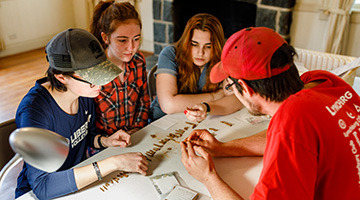
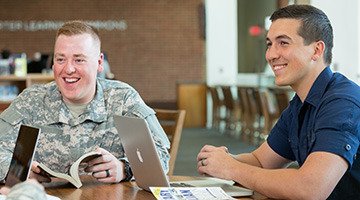
Prepare for a successful career while earning your bachelor’s, master’s, doctoral, associate, or minor in the area of History from Liberty University’s Department of Humanities. With our history, social sciences, and military studies degree programs, your knowledge of these fields will be enriched as you explore exciting career options.
Courses are taught from a Christian worldview by experienced professors who share your passion for history and are grounded in their faith. Interested in a career in politics, education, or communications? A degree from our Department of Humanities will get you ready for these career opportunities and more.
History Featured Areas of Study

View all History Degrees
- Earn a bachelor’s and master’s degree with our History dual degrees
- Enhance your degree with a History minor
- View history certificate programs offered by the Humanities Department
- For advising, contact history@liberty.edu
Featured History Faculty
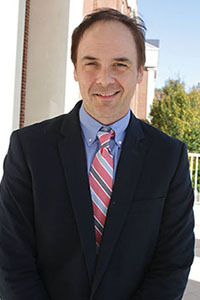



Dr. David Snead
Area Coordinator, Director of History Graduate Programs | Professor of History
View BioStudent Opportunities
Public History Projects
- Chaplains Museum
Open Monday through Friday 12:00 p.m.-4:30 p.m. and Saturday 10:00 a.m.-2:00 p.m. on the terrace level of the JF Library. Summer hours vary.
- New London Projects
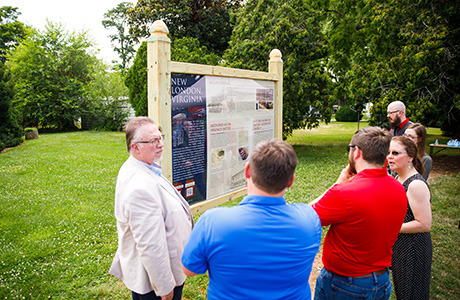
The New London projects give students hands-on opportunities in archaeology, historical architecture, historical interpretation, and much more.
- 250th Commemorative Conference
In honor of the 250th anniversary of the founding of the United States, the Department of History invites scholars, students, and researchers to participate in our commemorative conference, America’s Founding: Legacy and Influence. Join us as we reflect on the story of a nation and the faith, courage, and convictions that continue to shape it. Liberty University is proud to be a Commemorative Partner of VA250—Virginia’s American Revolution 250 Commission.

Start Your Journey as a Student at Liberty
What Our Alumni Say:
Fill out our Alumni Survey
Looking back on history can sometimes feel like navigating a map on the interstate. There are connected exits and off-ramps until you wonder, “How do I get where I’m going?” The start of the Second World War can also feel like this. It’s not as straightforward as we’d like it to be. So how did the Second World War come about?
German resentment over the Treaty of Versailles, the rise of Fascism and militarism, and policies of appeasement on the part of Britain and France converged into one of the deadliest global conflicts in human history. A humiliated Germany was reeling from the defeat of the First World War and a global economic depression. The “National Socialist German Workers Party,” or Nazis, became the largest party in the Reichstag, and Adolf Hitler was appointed chancellor in 1933, enabling their program of dismantling democratic institutions.
Fueled by Nazi beliefs in racial and national superiority, Hitler’s efforts to expand the boundaries of Germany met with a policy of appeasement, which resulted in the annexation of the Sudetenland in 1938. But that was not enough for Hitler’s vision of a future world power. German expansion continued with the annexation of Austria in 1938 and the occupation of the Czech lands in 1939. But when Germany invaded Poland in September 1939, Britain and France declared war.
The road to war is never a straight one and is often arrived at through more than one avenue. There was no single, isolated cause for the start of the Second World War, but rather a web of circumstances, ambitions, and fears that would ultimately cause the global conflict to unfold in the way we know it today.
Oct 5


📚 Meet Dr. Snead!
Get to know one of our History professors and learn more about his favorite areas of history, what inspired him to teach, and a few fun facts along the way! 👋
Stay tuned for more in our Meet the Professor series!
Sep 30

What a wonderful CFAW weekend!
The Department of Humanities-English, History, and Modern Languages-was delighted to meet so many prospective students and their families during College for a Weekend!
We enjoyed getting to know future Flames, sharing more about our programs, answering questions, and giving students a glimpse into the opportunities waiting for them at Liberty University.
Thank you to everyone who stopped by, connected with our faculty and staff, and spent part of your CFAW experience with the Department of Humanities. We loved meeting you and hope to see many of you again as future Flames!
English • History • Modern Languages
Department of Humanities | Liberty University
#CFAW #LibertyUniversity #DepartmentOfHumanities #History
Sep 21

As we approach the 25th anniversary of the September 11, 2001, attacks, we remember the nearly 3,000 lives lost and reflect on how memorials across the nation help preserve the memory and legacy of those who were taken from us.
In New York City, water cascades down into two pools which mark the place where the twin towers of the World Trade Center once stood. Designed by architects Michael Arad and Peter Walker, “Reflecting Absence” was chosen in 2004 to be the official design of the National 9/11 Memorial out of more than 5,000 submissions.
The 9/11 Pentagon Memorial sits near the west side of the Pentagon, the headquarters of the Department of War located in Arlington, V.A. Visitors will find rows of benches either pointing to or away from the building, with lines dividing the memorial by the ages of the victims. The memorial, titled “Light Benches,” was designed by architects Julie Beckman and Keith Kaseman, and was selected out of over 1,100 designs.
The final design of the Flight 93 National Memorial was chosen out of a similar number of entries for the Pentagon Memorial. Designed out of cooperation between Paul Murdoch Architects and Nelson Byrd Woltz Landscape Architects, “Crescent of Embrace” highlights the open spaces and landscape of “a common field one day,” which became a “field of honor forever.”
At Liberty University, part of the study of history includes not just looking at events and individuals, but also how they are remembered. This includes understanding the cultural and historical significance of memorials and monuments that call us to never forget.
Sep 11

Contact
(434) 592-4366
history@liberty.edu
DeMoss Hall 4334
Connect

