Liberty’s steel bridge team competes at national finals for third straight year
June 3, 2026 : By Ted Allen - Office of Communications & Public Engagement


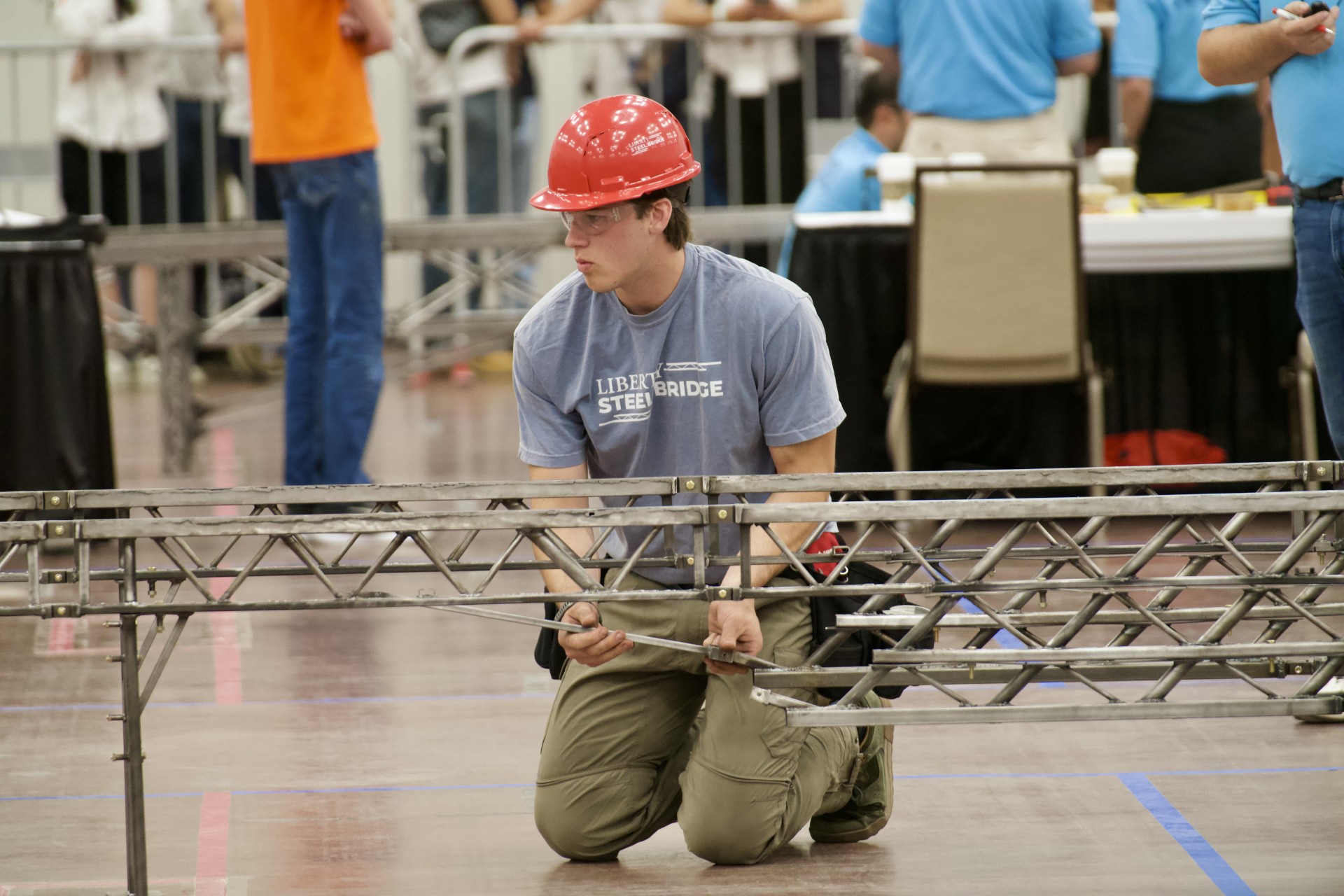
Liberty University’s Steel Bridge Competition Team from the School of Engineering tested its simulated model of a bridge over the Rio Grande River during the National Finals of the 2026 Student Steel Bridge Competition held May 22-23 at the University of Texas El Paso.
The team of civil engineering students spent the fall semester designing the bridge and the spring semester fabricating it in preparation for regional and national competitions. In early September, teams were tasked with the objective to design a 1:10 scale model of a steel pedestrian bridge over the Rio Grande River featuring a cantilever section with extended beams anchored at one end. The bridge had to be constructed on site in a timed event before being judged on aesthetics, construction speed, lightness (total weight), cost estimate, stiffness (deflection when loaded with 2,500 pounds), economy, and structural efficiency. It was also a requirement that clearance for navigation of ships beneath the bridge be maintained in the center span.
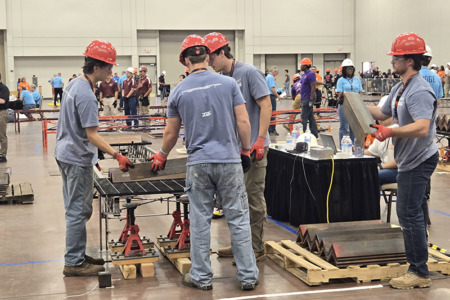
With improved structural support provided by new materials that arrived between competitions, Liberty significantly raised its scores in all categories following its showing at the American Society of Civil Engineers (ASCE) Virginias Regional (Virginia and West Virginia universities) event at Old Dominion University in Norfolk in April.
At that competition, Liberty’s steel bridge placed second to Virginia Tech for the third consecutive year, ahead of bridge models from Fairmont State (W.Va.) University, James Madison University, Marshall (W.Va.) University, ODU, the University of Virginia, Virginia Military Institute, and West Virginia University.
The competition was organized by the American Institute of Steel Construction (AISC) and the ASCE, which oversees 19 regional competitions across the United States, with more than 200 schools competing. Liberty and Virginia Tech represented the Virginias Region at nationals for the third consecutive year, and Liberty placed 27th out of 44 programs overall.
At nationals, registration, aesthetics judging, and a team captains meeting took place on May 22 before the main competition and awards banquet was staged on May 23.
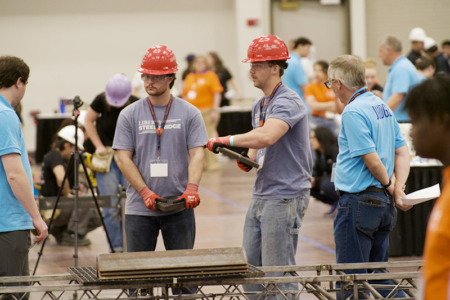
Liberty’s bridge ranked 24th in the stiffness category, with a 0.70 aggregate deflection. In construction speed, Liberty finished 31st with a completion time of 14 minutes, 24 seconds. The team placed 35th for lightness, with the project weighing in at 287.2 pounds. Aesthetically, the project ranked 32nd. The cost estimate of Liberty’s simulated bridge totaled $2,333,339.09, ranking it 36th in that category with its economy figure of $7,372,800, representing the cost-effectiveness of fabrication and assembly, ranking 29th. Liberty’s efficiency estimate of $4,514,312.67 — a key scoring category evaluating how well a bridge meets load and deflection requirements with minimal material — ranked 27th, matching its overall finish.
Complete results are available online.
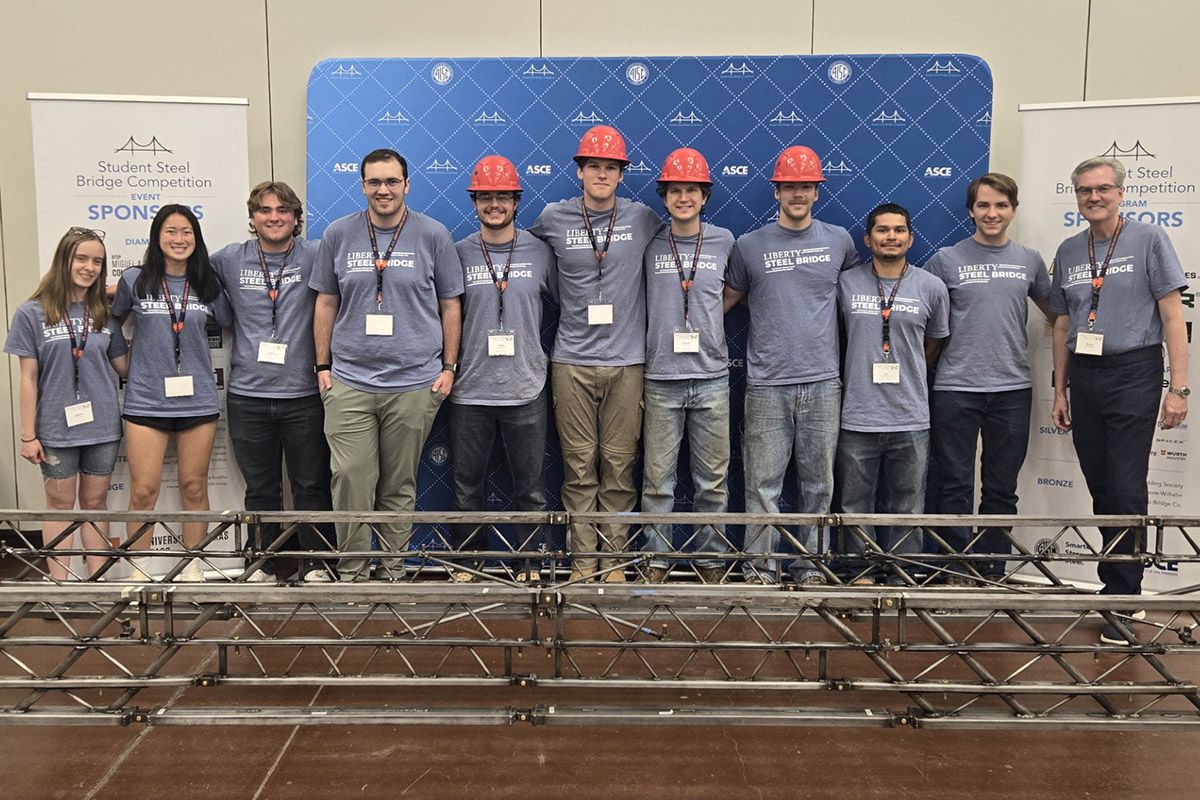
Team members who attended the national competition were graduating seniors Chad Parker, Trenton Langin, Collin Partington, and Samatha Helder; juniors Logan Grasser, Addelyn Gibson, Nate Nolley, and Luther Davis; and freshmen Colby Howden and Luis Loredo Martinez. They were accompanied to the competition by their faculty advisor, Assistant Professor Bryon Ringley. Builders at the National Finals were Parker, Partington, Langin, and Nolley.
Liberty’s Steel Bridge Competition team is one of seven competition teams offered through the School of Engineering, and one of two run through the civil engineering department, with the others incorporating elements of mechanical, electrical, computer, and industrial & systems engineering.
Approximately 30 members of Liberty’s ASCE student chapter attended the regional symposium in Norfolk, where the Concrete Canoe competition team placed sixth overall, the ASCE Survey team finished third, and the Construction Institute team was fourth.