Liberty Rocketry targets launch of its new OMEGA rocket at international competition in Texas
June 12, 2026 : By Ted Allen - Office of Communications & Public Engagement


UPDATE (07/06/26):
The Liberty Rocketry team’s OMEGA project placed 18th out of 141 teams entered, its second-best showing in four consecutive years of entering the International Rocket Engineering Competition (IREC), held June 14-20 in Spaceport Midland, Texas. View final results released this week, and read the full report.
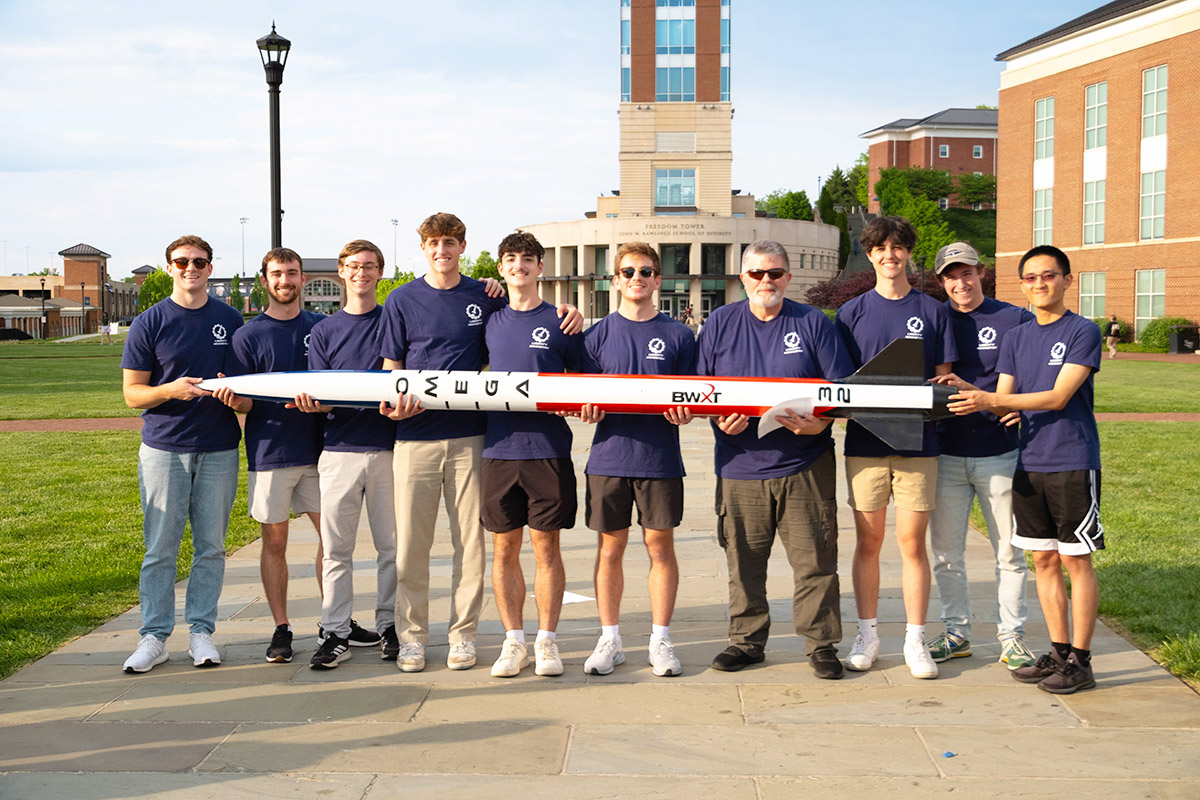
Coming off two of the most successful test launches in program history, the Liberty University Rocketry team has high expectations as it heads to the International Rocket Engineering Competition (IREC) starting Sunday and running through June 20 at Spaceport Midland, Texas.
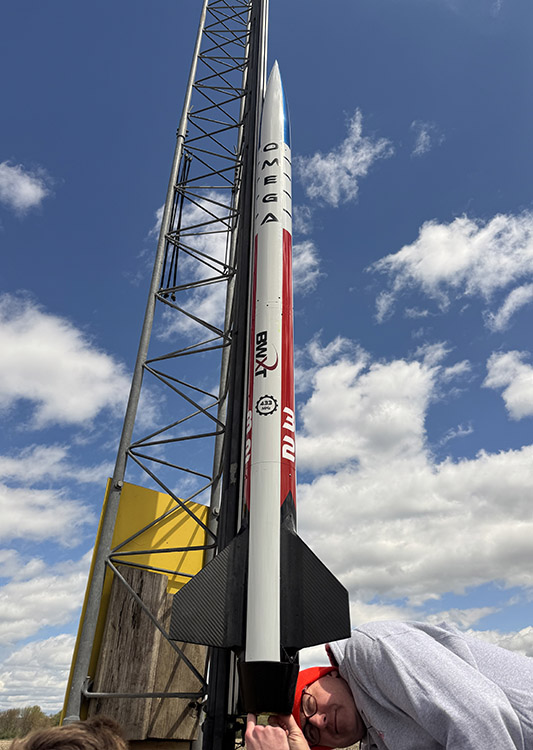
The team will showcase OMEGA, the fourth rocket designed and manufactured by students and their most sophisticated project to date. Liberty will compete with over 140 programs in the 10,000-foot Commercial-Off-The-Shelf (COTS) division at IREC, the largest annual intercollegiate rocketry competition in the world, hosted and run by the Experimental Sounding Rocket Association.
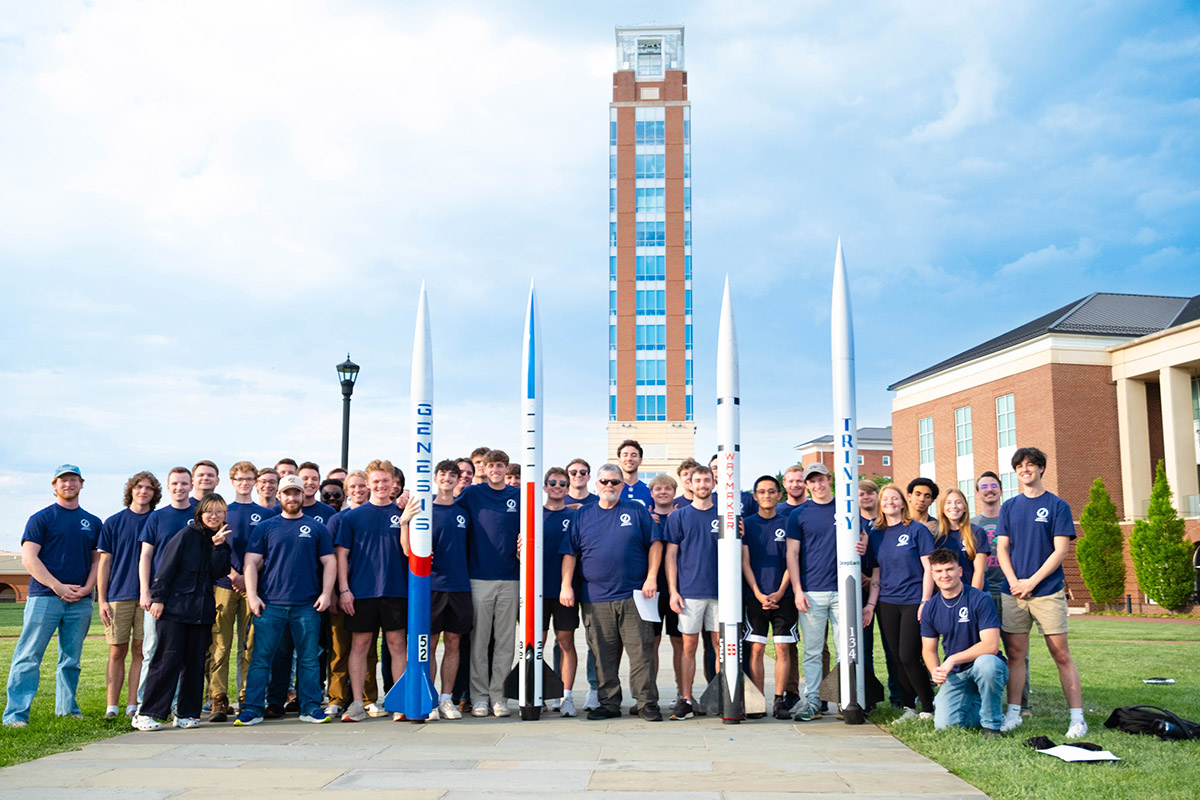
Team members said they are confident that OMEGA will continue the upward trajectory of a program that is pushing the bounds of spaceflight for God’s glory. They aim to improve on the performances of previous models — Genesis, which finished 39th in 2023; WAYMAKER, which skyrocketed to a ninth-place showing in 2024; and Trinity, which finished in 57th place last summer.
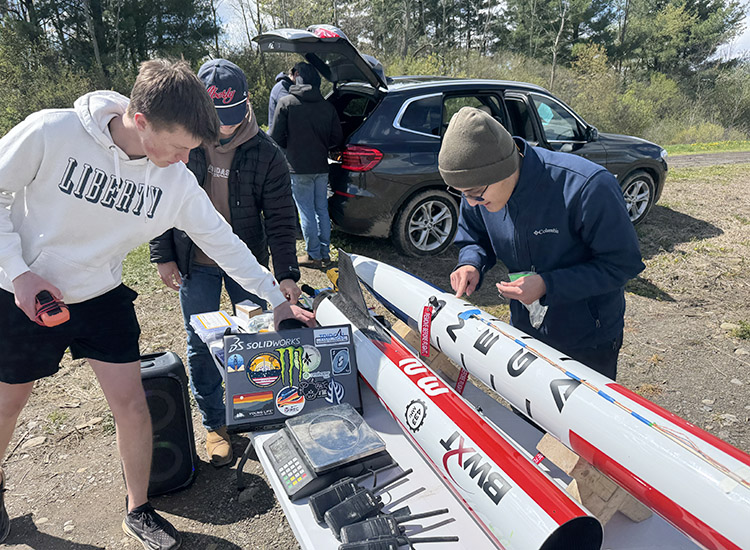
At the sub-scale test launch March 1 in Culpepper, Va., OMEGA reached an apogee of 4,485 feet, 48 feet above its simulated prediction altitude. At the full-scale test launch in upstate New York on May 2, OMEGA soared to 10,088 feet.
“That was just 88 feet off, making it the closest 10K launch in Liberty Rocketry history,” said OMEGA chief engineer Josh Cowell, a rising senior currently working in Washington, D.C. “For context, our previous best (Trinity) was 9,691 feet, 309 feet off. To put that into competition perspective, this (test) flight would have scored 339 out of a possible 350 points, placing us fourth in accuracy last year.”
OMEGA stands 3.17-meters tall and is capped by a fiberglass nosecone packed with avionics systems that transmit live data between a custom flight computer and ground station computer. The main fuselage features a payload section and a dual-deployment, dual-separation recovery system equipped with main and drogue parachutes. Beneath a six-inch carbon fiber airframe, OMEGA is powered by an Aerotech solid rocket motor sitting inside project’s signature trapezoidal tri-fin can. The fins and their fillets were manufactured using 3D printed jigs and placed above a molded boat tail design. (View the full poster of the rocket.)
A professional paint job donated by a local auto body shop enhanced the rocket’s aerodynamics and aesthetics.
“Surface roughness and drag play large roles in our simulation accuracy,” Cowell said. “With a professional auto paint job, all of the tiny holes in the carbon fiber body are filled, giving us an extremely consistent and smooth finish on our rocket.”
Cowell used a laser and optical microscope at Liberty’s Center for Engineering Research & Education (CERE) building to create a 3D map of the painted surface to determine its roughness down to the nanometer.
The IREC competition gives bonus points to projects that include a functional payload capable of performing a task while the rocket is in flight. OMEGA is packed with a 4.4-pound galvanometric laser engraver programmed by rising senior Caden Solle and his payload sub-team to operate after liftoff and complete a simple inscription by the time the rocket lands.
“For the first time in team history, the payload worked,” Cowell said after last month’s full-scale launch, noting previous rockets have carried concrete blocks to meet the minimum requirement. “Our onboard laser successfully engraved the intended pattern, and we hope to engrave a logo or the accelerometer data onto a piece of wood during the competition launch.”
Last summer’s 20th IREC event was attended by more than 2,000 students representing over 150 schools from 22 countries on six different continents, including Algeria, Australia, Canada, Colombia, India, Italy, Malaysia, Mexico, Saudi Arabia, South Korea, Turkey, the United Arab Emirates, and the United Kingdom. This year, 142 college and university programs are registered for the 10,000-foot Commercial-Off-The-Shelf (COTS) competition, the largest of multiple divisions. There are also teams competing in 30,000- and 45,00-foot divisions.
Thirteen Liberty Rocketry team members will travel to Texas for the competition. They could be called up to launch OMEGA on Wednesday, Thursday, or Friday. The competition can be viewed live on the ESRA website.
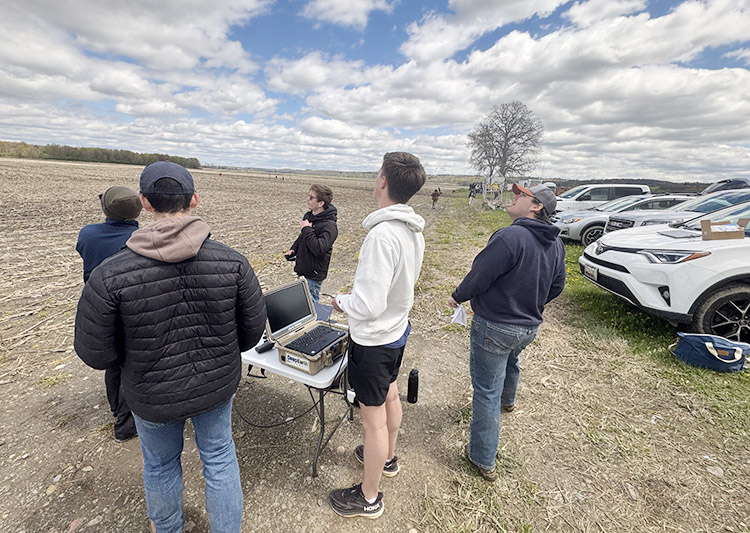
The team thanks their technical advisor, Mark Miller, who has 35 years of experience with high-powered rocketry and helped launch Liberty’s program and take it to the next level over the past four years. Miller (pictured in the group photos above and below) will not be traveling with the team.
“Mark Miller has been working with us pretty closely, and he has been huge since the start of the team as a whole,” Cowell said. “He has a lot of knowledge on general manufacturing, so he’s been an invaluable resource.”
In addition to the rocket launch itself, teams are required to submit a technical report.
Rising senior Kaden Newsome oversaw a project management sub-team staff that accelerated research and edits on the report and kept the team on track throughout the design and manufacturing processes.
“Our technical report has gone through a complete revamp,” Cowell said of the 110-page document. “We sent it out to a lot of professors and grad students this year to get professional advice on technical writing.”
>>Liberty Rocketry is one of several School of Engineering competition teams that provide exciting opportunities to help students connect their interests and integrate their classroom learning into real-world engineering projects.
Watch a documentary on OMEGA’s March 1 test launch produced by Caden Palmer, head of its media sub-team, and view an on-board video of its May 2 test launch set up by avionics sub-team co-lead Price Drawdy below: