Engineering students accelerate research in porous metals with ion beam machine
March 27, 2026 : By Ted Allen - Office of Communications & Public Engagement


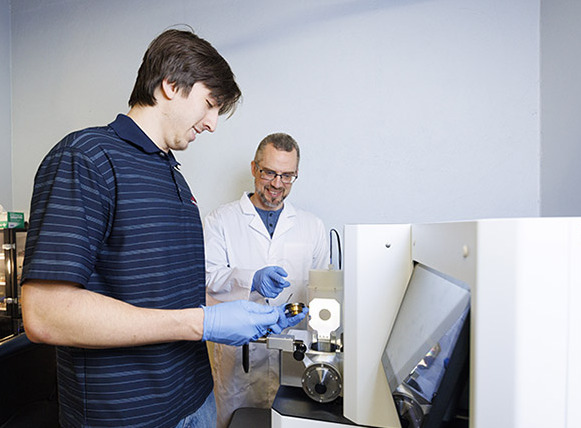
Liberty University School of Engineering students have been using a high-tech mechanical polishing machine made possible by a grant from the National Science Foundation to study the characteristics of porous metals and publish findings that could have practical implications for industries that use them for manufacturing, energy production, and other purposes.
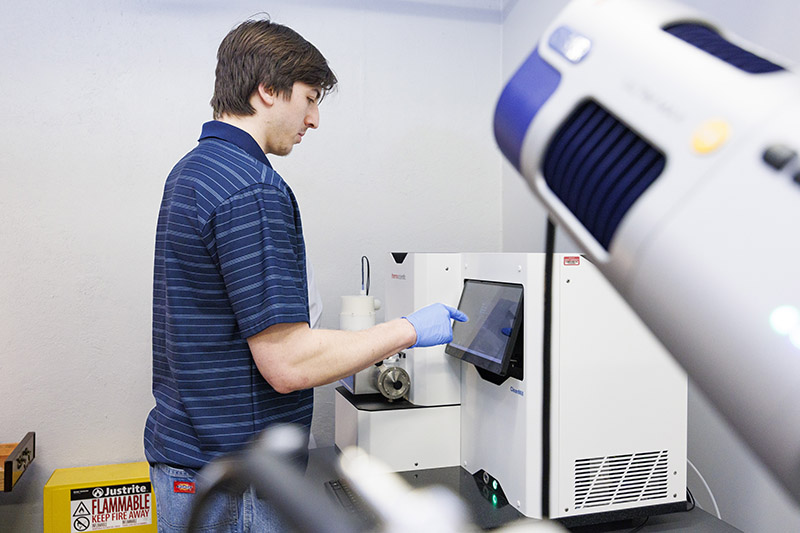
The Thermo Scientific CleanMill Broad Ion Beam System, commonly referred to as an ion mill, uses argon beams in a high-vacuum chamber to polish materials. The samples are transferred to the Scanning Electron Microscope (SEM), set up in the same sound- and vibration-insulated room at Liberty’s CERE research facility in nearby Bedford County, to produce high-resolution imaging that allows users to better analyze and characterize the metals’ pore morphology.
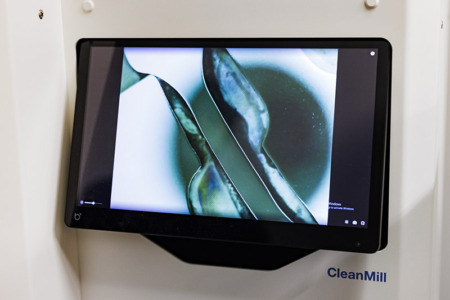
Liberty acquired the machine in 2023. In addition to being used by students and professors, it is commonly used by materials research and development scientists, production quality control specialists, and failure analysis engineers.
The machine provides advanced cross-section polishing of substances as hard as ceramics and steel and as malleable as magnesium — from copper and nickel to aluminum and lithium. The process can save hours or even days when compared with traditional techniques such as mounting, grinding, and vibratory polishing.
Associate Professor Dr. Mark Atwater, who is advising the research, said the ion mill is as easy to use as a microwave for food prep from kitchen to table. Because the mill uses a high-energy ion beam, it doesn’t damage the physical characteristics of the material being sampled. An intuitive touchscreen provides seamless automation for transferring samples to the microscope protected from oxidation.
“If you try polishing porous metals by hand using sandpaper, the pores are so small that it will tend to smear the metal over and close them up so you can’t see them,” Atwater explained. “The abrasive actually damages the material, and we are looking at such fine features under the microscope that any damage is very hard to get rid of. As a final step, doing ion milling is very helpful in reducing any kind of surface imperfections. Using this tool, we can do unique mechanical polishing that prepares the surface better, and more reliably, so we can get higher-quality scans and produce higher-quality data out of the microscope, and get it faster.”
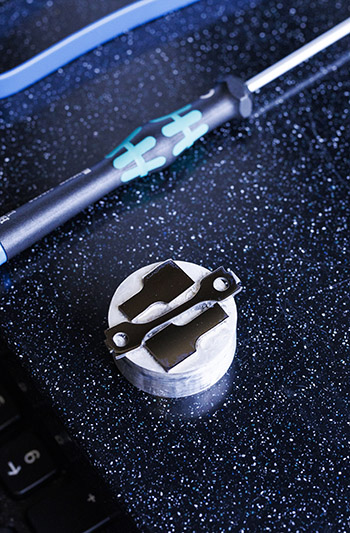
He said the ion mill is effective in processing materials that are hard to polish because of their chemistry by using liquid nitrogen to prepare heat-sensitive biological materials, including polymers such as rubbers and plastics.
Atwater is giving individual instruction and funded research opportunities to undergraduate students enrolled in the Directed Research elective (ENGR 495). Students have written Honors Scholars theses based on their research using the ion mill and the SEM, and the equipment is used extensively in the graduate-level Materials Characterization course (ENGR 837).
Last summer, Atwater and senior mechanical engineering student Oliver Fowler presented research at the Microscopy & Microanalysis Conference in Salt Lake City, after previously publishing peer-reviewed articles on porous materials in the Journal of Materials Characterization and also for Computers. Another article that used the ion mill extensively was accepted for publication in the journal Advanced Engineering Materials.
“In the (materials characterization) paper, we were looking at whether we could shortcut some of our material preparation,” Atwater said. “We found out in the end that we could save on the order of five hours of sample preparation and go straight to ion milling. Without any preceding sample prep at all, we would get the same information, so we’re essentially able to turn at minimum a five-hour process down to 40 minutes.”
The porous metal research could benefit companies with functional applications including catalysis, energy storage, or filtration.
The ion mill is already accelerating numerous projects.
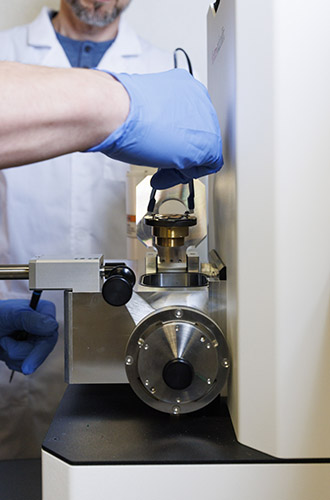
“We just finished a project with Framatome (an international leader in nuclear energy whose North America headquarters is based in Lynchburg), using the ion mill to provide some information on materials, and we’re hoping to continue working with them to collaborate on more projects,” Atwater said.
He said the mill and microscope have been helpful in studying aluminum properties for a project researching aircraft component repair, as well as stainless steel for a project involving components needed for nuclear energy production.
The mill has also supported an in-situ testing project with three industry partners.
“We were working with ZEISS that makes the microscope, Oxford Instruments which makes the analytical tools for chemistry and crystallographic information, and with Deben that makes the mechanical testing in-situ stage that goes into the microscope, so that you can pull on a sample and look at it under the microscope at the same time,” Atwater said. “Those companies together funded the projects that we just completed in January, and we’re working on new grants now.”
Atwater has developed an entrepreneurial outlook on materials science throughout his academic career in manufacturing, mechanical, and material science engineering.
“It has given me a unique perspective,” he said. “When I see a material science problem, I also think of it from like a manufacturing aspect and a mechanical aspect and ask, ‘How do we design something from that material?’ and ‘How do we actually make the thing that we designed?’”
Atwater has trained undergraduate and graduate students to approach research with a similar mindset.
“Dr. Atwater is awesome,” Fowler said. “He’s absolutely great to work with, extremely understanding and helpful in teaching me how to use these machines, and he was the main driver for me being on contracts with these companies. He’s been a real mentor throughout the process, taking the time to answer questions and making it intriguing and fun to learn.”
In turn, Fowler has been able to train fellow students on using the instruments and lend advice on advancing their research.
Fowler is currently working with NAVAIR in Cherry Hill, N.C., to complete his senior Capstone design project, designing a part for the V-22 Osprey helicopter’s prop rotor assembly. After graduation, Fowler plans to work as a research engineer in the shipbuilding industry.
“The processes and skills that I’ve learned through hands-on experience and working on competition teams (as a member of Formula SAE) are really invaluable and very much complementary to my studies,” Fowler said, noting he has picked up coding and computer-aided design techniques and materials theory principles through his research. “I wish I had started both sooner in my college time. I would have gotten even more out of my education, and it would have opened a lot more doors for me sooner. There is only so much you can learn in a classroom. Hands-on experience really pushes engineering education to another level.”