History

Get Your History Degree From a Christian University
Prepare for a successful career while earning your bachelor’s, master’s, doctoral, associate, or minor in the area of History from Liberty University’s Department of Humanities. With our history, social sciences, and military studies degree programs, your knowledge of these fields will be enriched as you explore exciting career options.
Courses are taught from a Christian worldview by experienced professors who share your passion for history and are grounded in their faith. Interested in a career in politics, education, or communications? A degree from our Department of Humanities will get you ready for these career opportunities and more.
History Featured Areas of Study



View all History Degrees
- Earn a bachelor’s and master’s degree with our History dual degrees
- Enhance your degree with a History minor
- View history certificate programs offered by the Humanities Department
- For advising, contact history@liberty.edu
Featured History Faculty





Student Opportunities
Public History Projects
- Chaplains Museum
Open Monday through Friday 12:00 p.m.-4:30 p.m. and Saturday 10:00 a.m.-2:00 p.m. on the terrace level of the JF Library. Summer hours vary.
- New London Projects
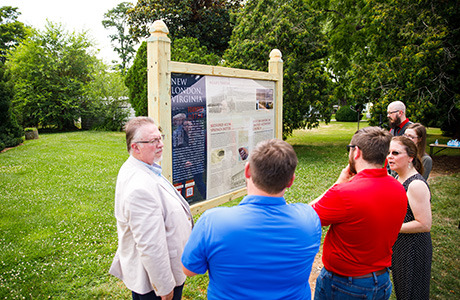
The New London projects give students hands-on opportunities in archaeology, historical architecture, historical interpretation, and much more.
- 250th Commemorative Conference
In honor of the 250th anniversary of the founding of the United States, the Department of History invites scholars, students, and researchers to participate in our commemorative conference, America’s Founding: Legacy and Influence. Join us as we reflect on the story of a nation and the faith, courage, and convictions that continue to shape it. Liberty University is proud to be a Commemorative Partner of VA250—Virginia’s American Revolution 250 Commission.

Start Your Journey as a Student at Liberty
What Our Alumni Say:
Fill out our Alumni Survey
At the eleventh hour of the eleventh day of the eleventh month in the year 1918, the guns of the Great War fell silent. The date is still remembered around the world, particularly in the nations that participated in “The War to End All Wars.” In France, the day is known as Armistice Day, commemorating the war and all who were lost in it. In the United Kingdom and the Commonwealth, Remembrance Day honors not only those who fell in the war, but all who have given their lives since. In the United States, however, the date’s significance has changed to honor all Americans who have served their nation in peace and in war.
In the immediate aftermath of the Great War, Americans remembered November 11th as Armistice Day. Though observed unofficially since 1919, Congress resolved to officially recognize Armistice Day as a national holiday in 1926. It wouldn`t be until the immediate aftermath of World War II that it would come to be known as Veterans Day.
Today, November 11, serves as a reminder not only of the armistice that brought the First World War to a close, but also of the generations of Americans who have answered the call to serve their country.
The Liberty University Department of Humanities extends its gratitude to all who have served in the United States Armed Forces. Through the continued study, preservation, and telling of our nation`s history, the History Area remains committed to ensuring that the stories of those who served—and the sacrifices they made—are remembered by generations to come.
Lest we forget.
Picture #1: New Yorkers celebrate Armistice Day on November 11, 1918.
Picture #2: The Lowry Air Force Base Color Guard participates in the annual Veterans Day Parade in Denver, Colorado, on November 11, 1963.
Picture #3: Thousands gather on Broad Street in New York City near a replica of the Statue of Liberty to celebrate the announcement of the armistice in November 1918.
#VeteransDay #ThankYouVeterans #HonorOurVeterans #MilitaryHistory #AmericanHistory #HistoryMatters #LibertyUniversity #LUHumanities
Nov 11


📣 History students, don’t miss this scholarship opportunity!
The John & Blanche Steinhoff Memorial Fund is offering:
🎓 Two $5,000 graduate scholarships for residential History M.A. students
📚 Two $2,500 undergraduate scholarships
For application information, email humanities@liberty.edu.
#LUHumanities #LibertyUniversity #HistoryMajors #ScholarshipOpportunity #Scholarships
Nov 9

As we enter November, we take a moment to remember the beginning of the Vietnam War, which officially began on November 1, 1955. Wars rarely result from a single cause. The Vietnam War emerged from the intersection of French colonialism, Vietnamese nationalism, political conflict within Vietnam, and Cold War rivalry. Three developments were especially important.
First was the collapse of French colonial rule. Vietnamese resistance to French control had a long history, but it intensified during and after World War II under Ho Chi Minh and the Viet Minh. After France’s defeat at Dien Bien Phu in 1954, the Geneva settlement created a temporary military division near the 17th parallel. Viet Minh forces regrouped in the North, while French Union forces withdrew to the South. Although nationwide elections were anticipated, they never occurred, and the temporary division hardened into rival governments.
Second was the Cold War policy of containment. The United States had supported France’s war effort and, after 1954, increasingly backed the anti-communist government of South Vietnam. American leaders feared that a communist victory in Vietnam might encourage neighboring countries to follow, an idea commonly known as the “domino theory.”
Third was the escalation of the conflict within Vietnam. Political instability in South Vietnam, the growing communist insurgency, and increasing North Vietnamese support for communist forces in the South deepened the war. Following a confirmed naval confrontation on August 2, 1964, and a second reported attack on August 4 that was later seriously disputed, Congress passed the Gulf of Tonkin Resolution. The resolution gave President Lyndon B. Johnson broad authority to expand American military involvement. In 1965, the United States began sustained bombing of North Vietnam and deployed major ground-combat forces to South Vietnam, marking a decisive escalation of the war.
The Vietnam War demonstrates the complexity of studying history. Historians must carefully examine primary and secondary sources, consider different viewpoints, and evaluate the events and circumstances that shaped the past.
Nov 3

📚 Meet Professor Donna Donald!
Get to know one of our History professors and learn more about her favorite areas of history, what inspired her to teach, and a few fun facts along the way! 👋
Stay tuned for more in our Meet the Professor series!
Oct 30

Contact
(434) 592-4366
history@liberty.edu
DeMoss Hall 4334
Connect

