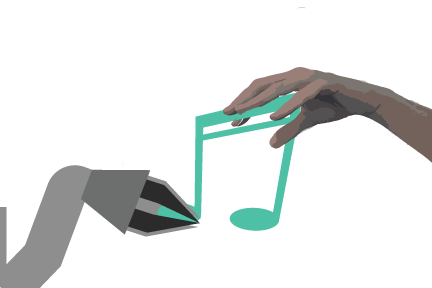
The growing presence of content created by artificial intelligence has many individuals and music artists concerned about whether they are consuming music made by humans or by machines. As AI has rapidly evolved over the past few years, that distinction has become increasingly difficult to make.
While AI can be a compelling tool for creativity, the rise of AI artists is already doing immeasurable harm to the music community and the listeners who trust the cultural economy of sound.
Popular music artist Xania Monet is a prime example of AI hiding in plain sight. Created by Telisha Jones, Monet is an avatar designed to turn her creator’s real-life experiences and poems into songs using AI.
According to cbsnews.com, Jones reviews her poems and then inputs the lyrics in an AI music-generator app, with prompts to specify musical style and then all she needs to do is click create and the song is ready.
One of Monet’s biggest songs, “How was I supposed to know?” was written after Jones lost her father at the age of 8. The track skyrocketed in popularity and helped put Monet’s name in front of a large audience.
Monet is the first known AI artist to appear on a Billboard radio chart, debuting on the Adult R&B Airplay and Emerging Artists charts at No. 30 and No. 18 respectively, according to billboard.com.
CNN reported the AI singer has more than 146,000 followers on Instagram, citing it as evidence that consumers are receptive of AI singers despite the ongoing concerns within the music industry.
Artists like Enlly Blue and Juno Skye are just a few more examples of AI making its way into the music world, according to billboard.com.
Opinions from musicians remain divided. Country artist Riley Green told Fox News Digital during the Academy of Country Music Awards that he was not concerned about AI singers because they fail to provide the raw emotions humans seek from music. In contrast, Tracy Lawrence expressed a more cautious approach, saying he wants regulations to be implemented to prevent AI music from getting out of hand, according to foxnews.com.
If you ask me, the advancement of AI in the 2020s is concerning to some degree. If a computer can convincingly masquerade as a human and create songs that rival or even surpass human-made music in popularity, then that has a significant impact on current and aspiring musicians across the world.
What is perhaps most alarming is that these automated characters are largely going unnoticed until they achieve mainstream success. This suggests that there are fake singers across a variety of platforms that produce content at a higher rate than some musicians.
This is not to say that AI is entirely bad or that artists who use it are wrong. If used properly, it can be a crucial steppingstone toward new ideas that could benefit the music world. However, without transparency or guardrails, the industry could see a major shift towards robot singers, taking work and opportunities for creativity away from humans.
Warden is the assistant sports editor for the Liberty Champion.