Board of Trustees celebrates Champion Center, looks ahead to future projects and programs that will safeguard Liberty’s Christian mission
October 27, 2026 : By Office of Communications & Public Engagement


Liberty University welcomed its Board of Trustees to campus last week for its regular fall meeting.
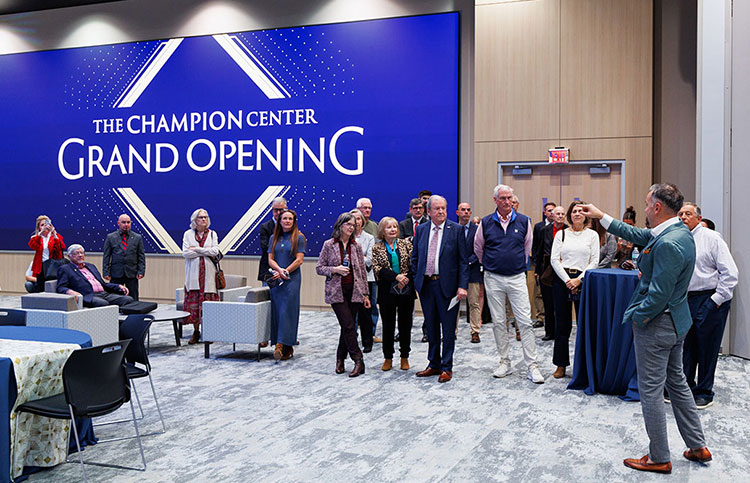
On Tuesday, Oct. 20, board members attended the grand opening of The Champion Center and toured the 64,000-square-foot facility, an extension of the Hancock Welcome Center that features multiple exhibits on Liberty’s history and the continued impact the university is making on the world. The building includes a large ballroom that accommodates 2,000, a Global Prayer Room that is open 24/7 with livestream capabilities, a theater, and a rooftop plaza. Board members celebrated the event with student and university leaders, local government officials, donors, and world-renowned evangelist and Samaritan’s Purse President Franklin Graham.
The formal Fall 2026 Board of Trustees meeting was held all day on Wednesday and focused on three major themes of discussion:
Mission in Action
The Academic and Student Affairs Committee began by presenting on several programs that show how academic innovation is creating new ways to serve students.
With the acquisition of the Virginia Technical Institute, Liberty’s technical studies program continues to grow and meet a national demand for skilled workers. This fall, the university launched LibertyLIFE, a new program that will open doors for students with an intellectual or developmental disability to experience college life in a safe and welcoming environment tailored to their specific needs. The three-year non-credit program helps students prepare to live a more independent life in the future. The committee also made presentations on how the university is preparing students to work responsibly in an AI-enabled economy and gave an update on biblical-worldview integration across the curriculum.
The board voted to approve the addition of 15 new academic programs, including a 90-hour bachelor’s degree.
Continuing its discussion from the spring meeting, the board heard a presentation from Liberty Chief Financial Officer Dr. Robert Ritz and Vice President of Student Financial Services Matt Cooper on preparing for a new era in higher education as federal student loan changes roll out under the One, Big, Beautiful Bill Act and academic programs across the nation could be affected by their graduates’ earnings benchmarks. They presented the university’s early evaluation process being used to identify programs at risk and to consider how to strategically protect students in “mission-critical” programs that serve the Church and advance Liberty’s mission of Training Champions for Christ.
The board was presented information on student demand and revenue in these programs and offered feedback on the developing in-house process, the factors and criteria it uses, and its effectiveness in assessing mission impact. The Trustees discussed actions that could be taken to protect students and prepare responsibly for potential loan eligibility impacts as early as 2028-29.
The Spiritual Missions Committee along with Chancellor Jonathan Falwell and Vice President of Spiritual Development Joshua Rutledge continued under the Mission in Action theme with reports that highlighted student spiritual engagement and the Spiritual Engagement Index (SEI), a new tool developed through the university’s Strategic Plan that helps answer a fundamental question: How will we know whether Liberty is succeeding in its mission of Training Champions for Christ? The SEI can give pastoral leadership a way to account for residential students’ participation in activities and disciplines that support their spiritual development and give university leadership overall greater visibility into the value of its programs for advancing its Christian mission.
Development Planning
Executive Vice President of Development Brian Mentzer presented an ambitious 10-year results plan that focuses on prospective donor constituencies, institutional priorities, institutional resources, prayer, spiritual impact, and Liberty’s long-term case for philanthropic support. He showed how a perspective on giving that frames philanthropy around opportunity rather than scarcity is appropriate. He said a purposeful message to supporters should be that making a gift to Liberty is an investment in a proven institution that can deploy resources directly toward student and Kingdom impact. The trustees offered their perspectives on the constituencies, priorities, and messages most likely to support philanthropic growth over the next decade.
Giving to Liberty reached a new milestone this fall when over $11.7 million was received during the school’s annual Giving Day on Sept. 30. Supporters gave to over 100 campaigns spanning academic, athletic, and spiritual programs, and Liberty was blessed with 9,002 gifts in 24 hours. Mentzer thanked the trustees for their 100% participation in Giving Day, which unlocked a challenge gift of $25,000.
Athletics
The final theme of the meeting centered on the vision for Liberty Athletics, recent success of its thriving NCAA Division I programs, the rapidly changing NIL environment, and the level and allocation of investment needed to sustain the university’s desired competitive position.
Vice President and Director of Athletics Ian McCaw reminded the board of the significant competitive success that Liberty has experienced recently, including 36 conference championships over the last three years, and the steps all programs are taking to advance academic and mission outcomes. For the third consecutive year, Liberty Athletics earned the Conference USA Institutional Excellence Award, ending the 2025-26 school year with a 3.42 cumulative GPA, the highest mark among all CUSA schools and best year-end mark in athletics department history. This past summer, 15 student-athletes traveled to Rio Hondo, Guatemala, on a mission trip made possible by the new Tom and Christine Dewberry Athletics Mission Fund.
McCaw also presented on major rapid changes in the college athletics landscape following the House vs. NCAA settlement in June 2025, which officially allowed universities to pay student-athletes through direct revenue sharing, NIL, and donor groups to compete in their respective programs. (In 2021, the NCAA adopted a uniform policy suspending name, image, and likeness rules, opening the door for student-athletes to receive unlimited monetary compensation for any use of their likeness.) This year, Liberty joined more than 290 colleges in endorsing the Protect College Sports Act, a bipartisan federal bill dedicated to providing further clarity on issues related to name, image, and likeness in college athletics. The show of support came after members of Liberty’s leadership held a discussion in June with U.S. Sen. Ted Cruz (R-Texas), who introduced the bill.
McCaw reported that benchmarking indicates Liberty is at the top of Conference USA in NIL resources and competitive within the Group of Six. He said Liberty has engaged a consultant to assist with strategy, efficiency, and effectiveness in NIL to ensure the University remains competitive.
Board members offered their input on the role Liberty Athletics should play in advancing the university’s mission and national profile as the nature of college athletics evolves. They discussed the sufficiency of the present NIL approach and principles that should guide future investments. The Board endorsed leadership’s approach.
More committee reports and a special report from President Dondi E. Costin followed the main themes of the meeting.
Costin gave an update on Liberty’s recent selection for America’s Corps of Cadets, a new program established by the U.S. Department of War “to address the need for more officers grounded in the Constitution, Western civilization, American heritage, and the warrior ethos at a time when many traditional commissioning sources have drifted from those foundations.” The program will build on the existing Corps of Cadets at the nation’s six Senior Military Colleges and designate Liberty as a Distinguished Military College, requiring exceptionally high standards of cadet discipline, tactical instruction, and military organization. Liberty would also receive Honor School status, which provides priority in officer commissioning and pathways for civilian cadets’ service in the government. Liberty joins Louisiana State University, Tuskegee University, Mississippi State University, and Hillsdale College on the list.
Costin said establishing a Corps of Cadets would allow Liberty to expand structured leadership development, physical training, and a shared culture of excellence modeled on the highest traditions of American military education. He informed the board that the university is ready to collaborate with the Department of War to prepare even more future officers and civilian leaders to meet the demands of national defense.
Senior Vice President for Ethics and Compliance Jeff Hurlbert then presented on Secretary of Education Linda McMahon’s National Call to Action to University Presidents and Governing Boards, which requested that institutions publish responses to eight questions concerning matters of interest to the Trump administration by Jan. 1, 2027. The questions address merit-based admissions; the free exchange of ideas; intellectual pluralism among faculty and in research; cost and affordability; academic rigor and excellence in the AI age; foreign influence and research integrity; and the advancement of national security, workforce, and economic prosperity. The Board of Trustees discussed the university’s response, which will be submitted to the Department of Education and published on the university’s website next month.
A concept design and phased cost plan for a new multi-story academic building at the site of the former dining hall was presented by the Facilities & Campus Development Committee. The initial plan currently calls for a 315,000-square-foot facility that would combine general academic space with engineering teaching laboratories, computer laboratories, auditorium, student services, offices, and collaboration areas and support functions. The committee also presented new renderings of the approved Vines Center seating expansion project that could add up to 4,000 seats in a full balcony ring.
Other news from the Fall 2026 Board of Trustees meeting:
- The Investment Committee reported that Total Investable Assets increased to $3.67 billion at June 30, 2026, with investment gains and a contribution from operating reserves being the largest contributors of the increase.
- The board reviewed and accepted the annual independent audit report prepared by BDO for fiscal year 2025-26.
- The board approved the reappointment of six trustees to a new three-year term: Dr. John Borek, John Heath, Carroll Hudson, Penny Nance, Dr. David Rhodenhizer, and Gilbert Tinney.
- The Executive Committee reported its annual evaluations of the President and Chancellor, and the board accepted the reports.
- The board approved a revision to university bylaws regarding the succession plan in the event that the president is unable to perform his role, adding two more lines of order: Chancellor, Provost, CFO. (The previous plan included one line while relevant government guidance and industry best practices suggest having three.)
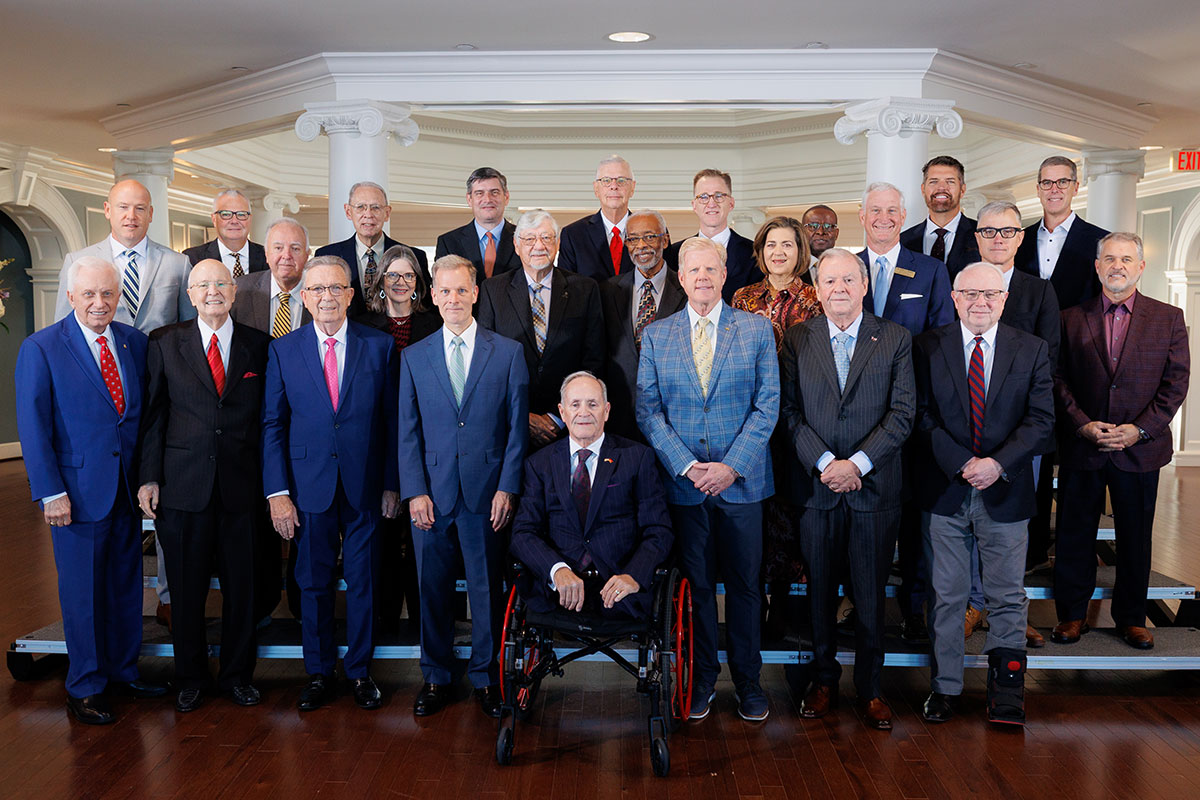
The Liberty University Board of Trustees holds two on-campus meetings each school year, in the fall and spring, as well as several special meetings between those two regular meetings. The board is structured to uphold the university’s founding mission while maintaining the operational efficiency necessary to remain competitive in a highly regulated and rapidly evolving higher education landscape.
The board is organized into seven committees: spiritual mission, investment, audit, budget and finance, academic and student affairs, facilities and campus development, and the executive committee. (View committee membership on the board webpage). The committees meet throughout the year and play a critical role in enabling focused, in-depth oversight of complex issues such as financial management, construction, governance, and long-term strategy areas that would be difficult for the full board to address with the same level of detail and efficiency. The committee work between meetings provides essential guidance that informs those board actions. All trustees serve on at least one committee, and many serve on multiple committees, a practice that ensures broad participation and an active role for board members in the university’s governance.
In keeping with the tradition set by Liberty founder Dr. Jerry Falwell to have a well-balanced board of trustees made up of both pastors or ministry leaders and Christian business leaders, the 31-member board currently has 16 members with backgrounds in business and 15 from ministry.