Liberty University lends support to Protect College Sports Act
August 1, 2026 : By Christian Shields - Office of Communications & Public Engagement



Liberty University has joined more than 290 colleges in endorsing the Protect College Sports Act, a bipartisan federal bill dedicated to providing further clarity on issues related to name, image, and likeness in college athletics. The show of support came after members of Liberty’s leadership held a discussion in June with U.S. Sen. Ted Cruz (R-Texas), who introduced the bill.
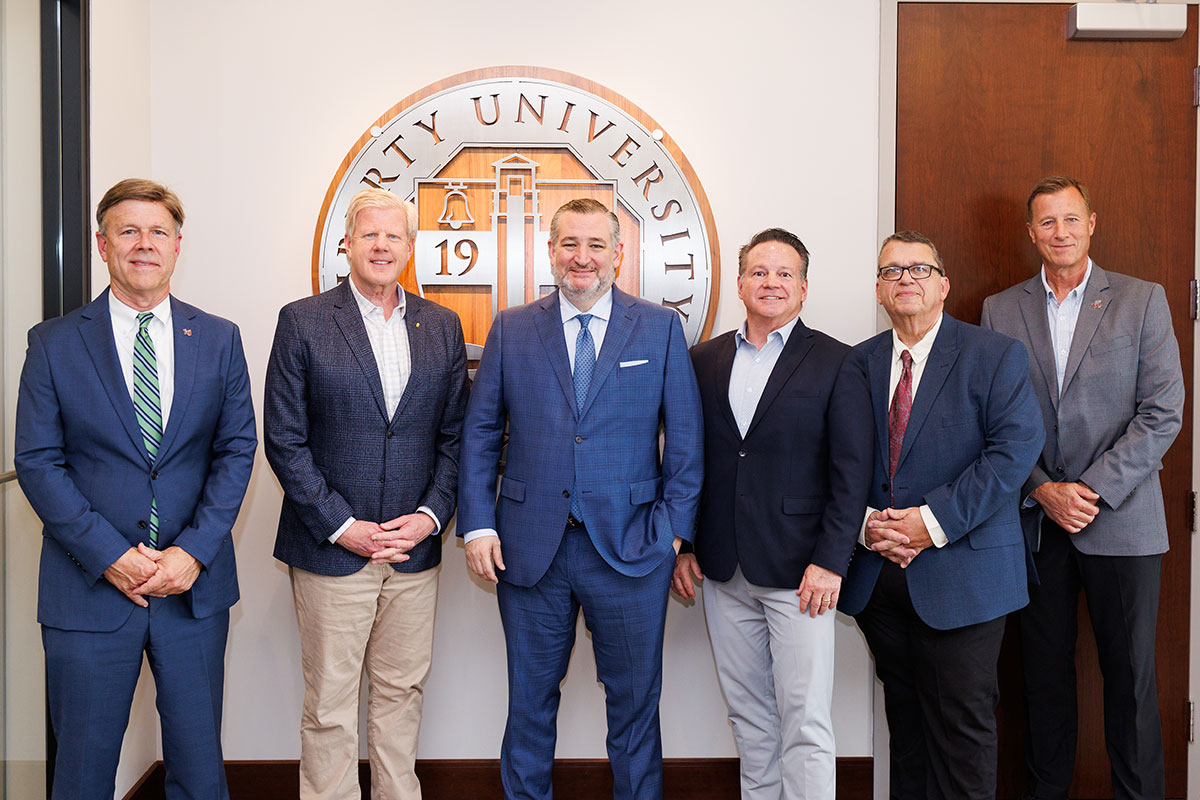
Cruz visited campus on June 5 for the 2026 National American Christian Lawmakers National Policy Conference, where he gave a keynote address. Before that event, he met with Liberty leaders to share details from the bill that he introduced alongside U.S. Sen. Maria Cantwell (D-Wash.), Eric Schmitt (R-Mo.), and Chris Coons (D-Del.) in the Senate in May. He opened the floor to questions from Liberty leadership, which included Chancellor Jonathan Falwell, Chief Financial Officer Dr. Robert Ritz, Senior Associate Athletic Director for Finance and Business Strategy Todd Patulski, Director of Government and Community Relations Kenny Craig, and General Counsel David Corry.
Student-athlete compensation has become a contentious issue in college athletics in recent years. In 2021, the NCAA adopted a uniform policy suspending name, image, and likeness rules, opening the door for student-athletes to receive unlimited monetary compensation for any use of their likeness. In June 2025, the $2.8 billion House vs. NCAA settlement officially allowed universities to pay student-athletes through direct revenue sharing, NIL, and donor groups to compete in their respective programs.
“There is a real urgency for Congress to act,” Cruz said during the meeting. “College sports is in complete chaos right now. I think if Congress doesn’t act, we may continue to see more and more devastation. It seems every week you’re seeing schools canceling programs — women’s sports, Olympic sports, track & field, tennis. You have an out-of-control cost spiral that everyone is dealing with. Congress created the problem because there used to be rules, and they all got struck down under the antitrust laws, which means that only Congress can fix it.”
The Protect College Sports Act includes various legislative measures seeking to establish concrete rules regarding the transfer portal and student-athlete compensation. The proposed bill would cap transfers to one per athlete without sitting out for a year (excluding specific circumstances such as the departure of the team’s head coach), restricts eligibility to five years, provides opportunities for schools to pool media rights to earn competitive rates for game broadcasts, prohibits the creation of larger schools into a “super league,” and more. (Since the bill’s introduction, the NCAA has already capped student-athlete eligibility to five years at the Division I level.)
In June, additional provisions were added to the bill as it passed the U.S. Senate Committee on Commerce, Science, and Transportation, advancing to the full Senate for consideration. These updates prevent major colleges (with more than $80 million in athletic revenue) from cutting the number of women’s and Olympic teams to below what they fielded in the 2024-25 academic year. All Division I schools must also maintain a set minimum number of roster spots and athletic programs.

Cruz argued the current legal obscurity surrounding student-athlete compensation has allowed large collegiate programs to grow stronger at the expense of smaller programs.
The senator emphasized his support for student-athletes’ right to receive compensation for their efforts on the field but also noted the need for legislation to ensure collegiate athletics remain competitive and fair for programs unable or unwilling to spend large sums of money to attract top-ranked student-athletes.
“The bill protects a student’s right to receive genuine NIL,” he explained. “If a quarterback can sell millions of tennis shoes, he should make millions of dollars. But it has to be real and have a valid business purpose, not just a booster with a bag of cash in a back alleyway. It also protects revenue-sharing a school can do but under the caps agreed to. I think it’s a better and more fair system that athletes are earning the fruits of their labor. But you’ve got to constrain the growth, or you’ll end up bankrupting everyone.”
Liberty Athletics currently fields 20 Division I athletic programs.
“I’m honored that Senator Cruz would take the time to provide university leaders a detailed overview of the Protect College Sports Act during his recent visit to campus. Even more, I admire the courage of Senators Cruz and Cantwell in tackling this critical issue in a way that delivers meaningful solutions,” said Liberty President Dondi E. Costin. “In addition to providing comprehensive physical, mental, academic, and spiritual support to every student-athlete, Liberty is committed to ensuring our student-athletes are competitively rewarded as we become increasingly competitive on the national stage. The university will likewise remain committed to ensuring the continued integrity of collegiate athletics in this new era.”
Under the current structure, Cruz said some student-athletes could feel less incentive to compete in collegiate athletics.
“Sports is such a powerful avenue for young people to go to college,” he said. “I don’t worry about the top 1%; the superstars, the Michael Jordans of the world, they’ll be fine. They’ll make billions of dollars and have a great career. Ninety-nine percent of college athletes will never play pro. They’ll never play in the NFL, never play in the NBA. Right now there are more than 500,000 student-athletes competing in America, (and) I think in five years that number drops in half (if we don’t do anything). That’s a horrible outcome for America.”
The Protect College Sports Act is rapidly gaining stakeholder and bipartisan support. Earlier this week, Senators Shelley Moore Capito (R-W.Va.) and Peter Welch (D-Vt.) became the latest senators to cosponsor the legislation. In addition to the 24 collegiate athletic conferences and more than 290 colleges and universities that have supported the bill, endorsements have also come from the United States Olympic & Paralympic Committee (USOPC), Team USA Athletes’ Commission, National Governing Body Council (NGBC), National Football League (NFL), Major League Baseball (MLB), National Basketball Association (NBA), National Hockey League (NHL), and the NFL and NBA players associations.