Liberty Belles crews soar to first and third place in historic Air Race Classic
July 2, 2026 : By Ted Allen - Office of Communications & Public Engagement


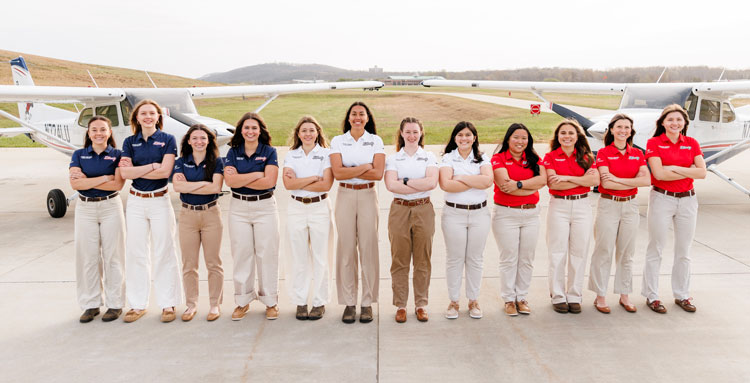
Two Liberty Belles planes from the Liberty University School of Aeronautics finished first and third in last week’s 49th Air Race Classic, an all-female competition that took crews on a 2,745-mile course from Illinois through Kentucky, South Carolina, Georgia, Alabama, Mississippi, Arkansas, Missouri, Wisconsin, and back to Illinois.
The event dates back to 1929 with the first Women’s Air Derby that featured Amelia Earhart among its competitors.
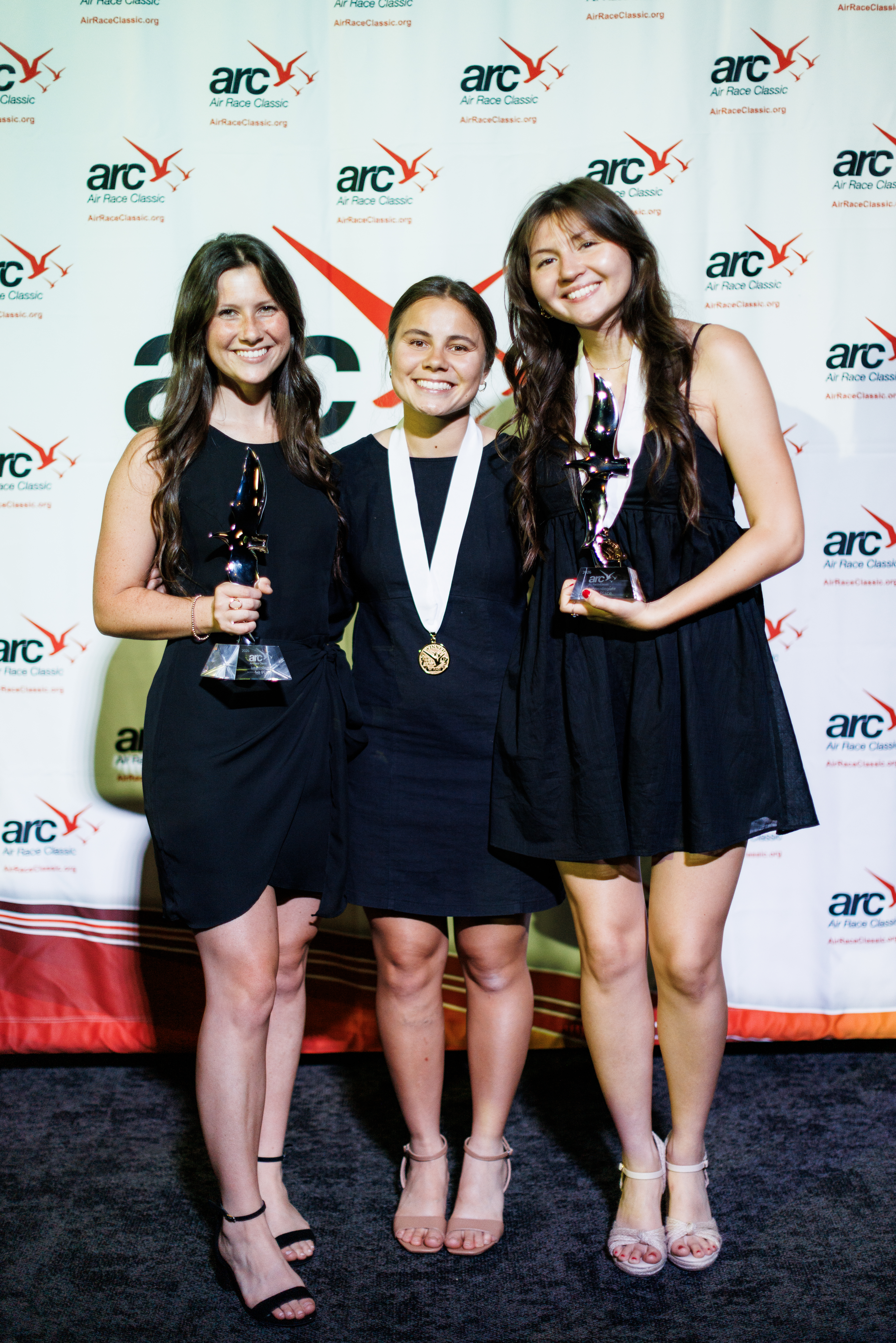
The winning plane, Liberty Belles I, was piloted by Sarah Schumann (’25) and co-piloted by rising senior Moriah Langford with Maddison Simkins (’26) serving as the back-seat navigator. All three recently became certified flight instructors for Liberty.
The Liberty Belles III plane piloted by rising senior Chloe Leonard with Ashley Asselin (’24) as co-pilot and Ashley Legoas (’25) as navigator finished third behind Purdue University and ahead of two tandems from Embry-Riddle University Prescott (Ariz.) that rounded out the top five. (See complete race results online.)
“Crossing the finish line, there is not a feeling that beats that,” Langford said. “It is so exciting, and you are filled with a lot of gratitude to be there with your teammates. It is awesome that we get to come together and celebrate something we’re all so passionate about by flying in a race. It is such a cool experience that I don’t think you can find anywhere in the world.”
“They did an awesome job,” said Liberty Director of Flight Safety Meredith Boardman, who served as one of the Liberty Belles’ three coaches along with Associate Director of Advanced Programs Liv Lewis and Special Programs Coordinator Erin Stewart. “We are really proud of all of them representing Liberty and the School of Aeronautics’ mission to equip, mentor, and send Champions for Christ into the aerospace community.”
A storm system over Illinois on Friday prevented more than half of the teams from completing the course, with only 11 out of 22 intercollegiate teams and 11 out of 23 non-collegiate tandems going the distance. Most of the 23 teams that did not finish, including Liberty Belles II, were stranded on the final leg, just over 100 miles north of their destination, Mt. Vernon (Ill.) Outland Airport.
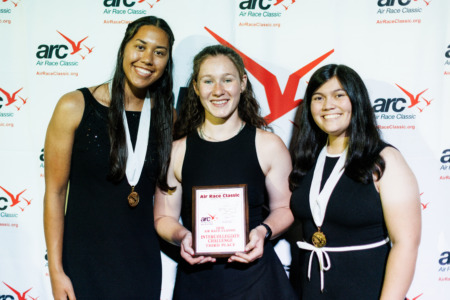
The Liberty Belles II crew was piloted by rising senior Isabella Hauri and co-piloted by Katrina Schlenker (’26) with rising senior Sydney Sullivan in the back seat.
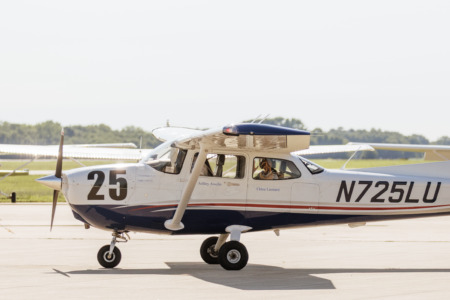
The three Cessna Skyhawk 172 planes left Lynchburg on June 19, and the race began on June 23 from St. Louis Regional Airport in East Alton, Ill. Although the flight course required mandatory stops in nine states, this was the first time in several years that the Air Race Classic ended in the same state that it began. From Illinois, they continued with stops at Capital City Airport in Frankfort, Ky.; Spartanburg (S.C.) Downtown Memorial Airport; Douglas (Ga.) Municipal Airport; Pryor Field Regional Airport in Tanner, Ala.; McComb-Pike County (Miss.) Airport; Russellville (Ark.) Regional Airport; Rosecrans Memorial Airport in St. Joseph, Mo.; and Prairie Du Chien (Wisc.) Municipal Airport before heading back to southern Illinois.
For the most part, aside from where storm activity limited visibility, the route was scenic.
“It was very beautiful,” Langford said. “It was really green, with the terrain very hilly with a lot of little mountains but mostly flat. It was definitely a very strategic race. Last year, since the terrain was so high, so much of the strategy was about altitude. We had to get above it or figure out where the valleys were.”
This year, weather played a much greater role, with a major storm system circling over the flight path.
“Thunderstorms are definitely something we talked about ahead of time,” Langford said. “This year, with it being a flatter course, we had more freedom to climb to different altitudes, trying to figure out how to maximize tailwinds and minimize headwinds.”
She said the aviation industry has implemented several new safety protocols over the last two decades. Liberty’s pilots are required to pass a flight risk analysis tool (FRAT) assessing their flight readiness based on factors such as how much sleep they’ve had, and must receive approval from a coach designated daily as the supervisor of flights.
“This race is a really great opportunity to step into that role, to determine what is the safest option,” Langford said, noting a camaraderie develops between pilots, navigators, ground crew, and coaches working toward the same goal. “The relationships you build at this race are truly unique, unlike any other relationships I have had in aviation. It is such a niche experience only so many people can say they’ve been a part of, and that makes it really special.”
Each plane receives a handicap, and teams race against their own best time, not one another, creating a level playing field between planes of varying speeds. Teams plan their departure times and determine their flight altitudes to take advantage of the best conditions with winds in their favor to try to beat their handicap speed by the greatest margin possible.
This year, for the first time, the Liberty Belles had three ground crew members (one for each team) who assisted the flight crews with the weather planning and flight planning. Anna Rotter (’26), a current CFI, worked with Liberty Belles I; Taylor Sullivan served Liberty Belles III, and Sarah Hiott was assigned to Liberty Belles II.
“We were so fortunate that Liberty allowed us to bring a third team, and to introduce a ground team this year,” said Lewis, who was a pilot for the Liberty Belles when they took first place in 2023. She noted it allowed more female aviation students the opportunity to participate and see what the race is all about before potentially flying in future years. “It was really awesome to have another set of eyes as a team. Our ground team was fantastic, very diligent in their weather planning and suggestions to the teams, and that proved very valuable in a year in which the weather played such a huge factor.”
At Sunday’s awards banquet, Liberty Belles I was awarded a first-place trophy and $3,000 to help fund next year’s race. Liberty Belles III received $1,000 and a plaque.
The Air Race Classic’s primary goals are “encouraging and educating current and future women pilots,” “demonstrating women’s roles in aviation,” and “preserving and promoting the tradition of pioneering women in aviation.”
“We find the Air Race to be a great demonstration of the students’ skills, knowledge, and education they have received at Liberty, and a really practical application of that training,” Boardman said. “It exposes them to challenging weather patterns, external pressures of the competition, and even crew resource management. Liberty offers a phenomenal flight training program, and their performance is reflective of the education they have received and the really hard work that they have put into it.”