Liberty makes major investments in aviation training with new high-tech simulator and safety aircraft
January 28, 2026 : By Ted Allen - Office of Communications & Public Engagement


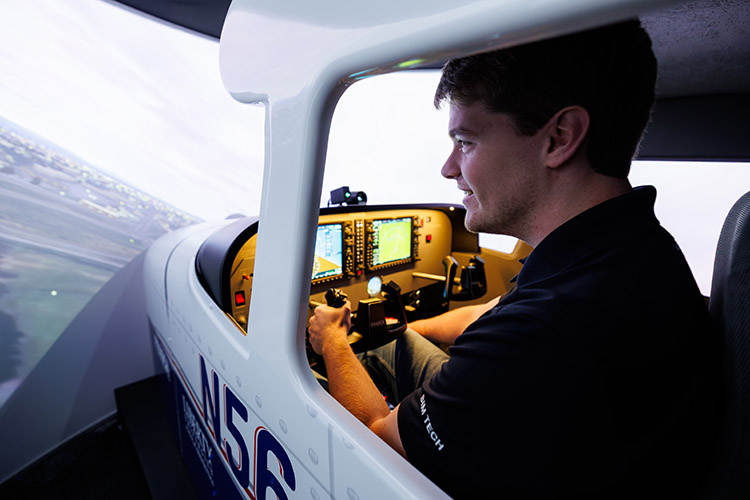
Students in Liberty University’s School of Aeronautics have a clearer vision and safer flight path toward careers in aviation this fall with two recent additions to boost its hands-on training: a state-of-the-art flight simulator with an upgraded visual package and a new aircraft that allows pilots to conduct safety training to prevent and recover from dangerous in-flight scenarios caused by mechanical issues or weather conditions.
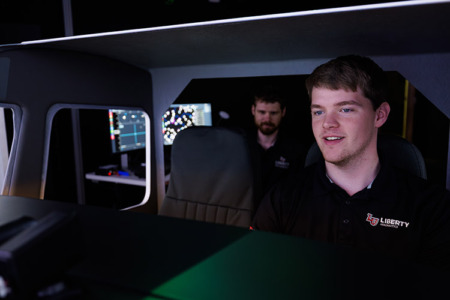
In June, the school acquired a new Frasca Advanced Aviation Training Device (AATD, or flight simulator) and in October its staff upgraded the visual system to Frasca’s new VITAL FVS 100 system. This new simulator joins four other Level 5 Flight Training Devices (FTDs) the school’s simulator center in DeMoss Hall. Liberty’s School of Aeronautics is one of only a select group of collegiate aviation programs in the nation to possess flight simulators that are certified by the Federal Aviation Administration’s National Simulator Program.
The newest simulator was developed using Unreal Engine software that delivers unprecedented realism, scalability, and innovation in pilot training. The VITAL FVS 100 system provides advanced visuals that significantly enhance the student pilot’s flight training experience.
“We’re one of two schools that have this simulator with the new visual system,” Director of Simulator Operations Dwight Williams said, noting Embry-Riddle Aeronautical University is the other. “Right now, this is top of the line.”
The setup is ideal for student pilots training to fly the newest version of the Cessna Skyhawk. Liberty currently has 28 Skyhawks (including five of the newest models) in addition to five Piper Seminoles and the newly acquired Extra 300 in its fleet.
“Frasca’s next-generation visual system advances the simulation of realism further than ever before,” Frasca International President John Frasca said in a news release. “Pilots training on this platform will experience visuals and environments that are more immersive and realistic, leading to stronger preparedness and readiness for real-world situations.”
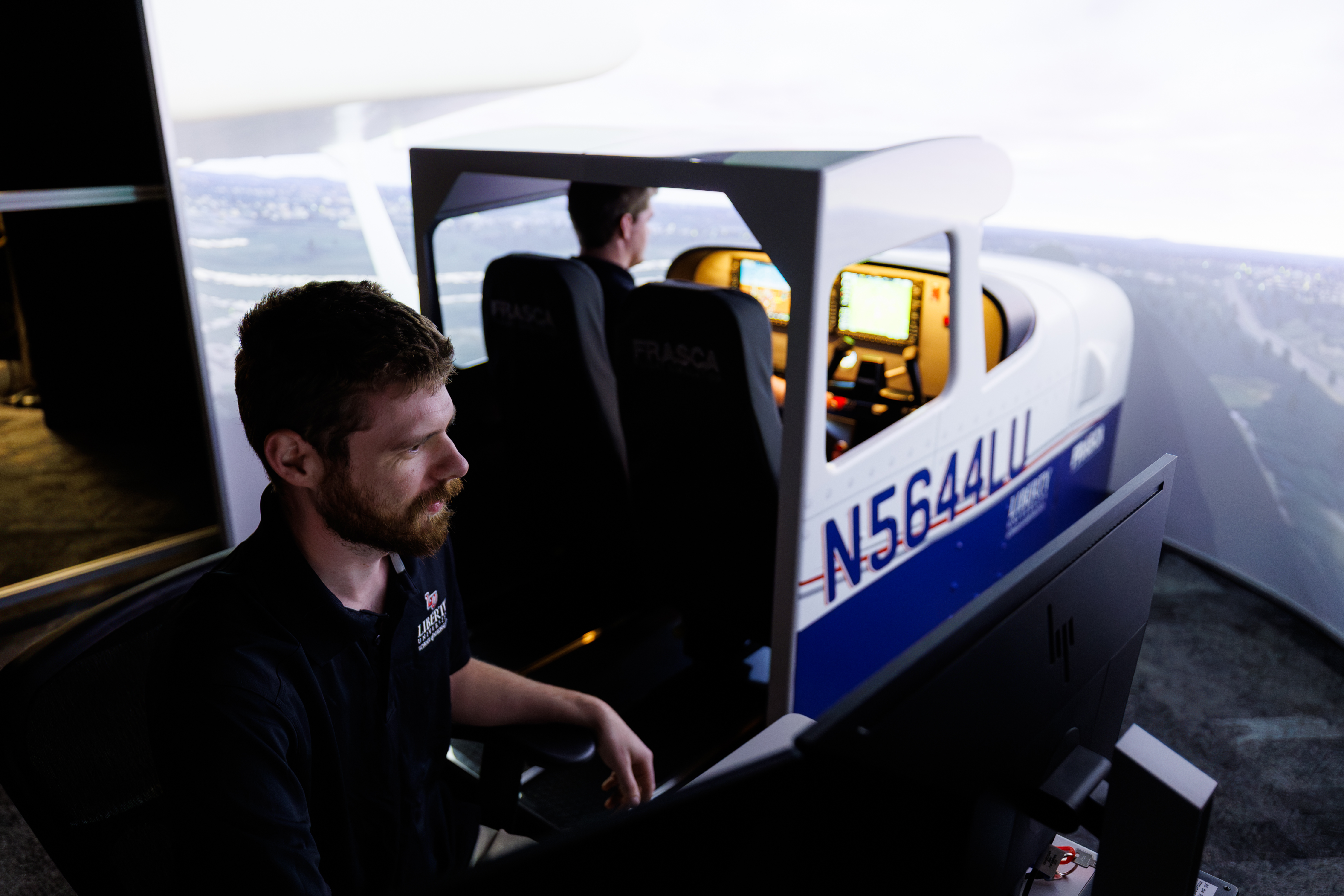
About 20 percent of student pilots’ training is spent in Liberty’s flight simulators, providing excellent instruction in realistic environments. These simulators are equipped with 220-degree wrap-around visual screens and the same Garmin G1000 glass cockpit avionics systems installed in the Cessna Skyhawk and Piper Seminole aircraft. They also feature active control loading, so students can feel the motions (like in a 4D theater) that replicate real-world control forces within the aircraft.
The other four Frasca FTDs operate on the TruVision Global platform, which projects a highly detailed and realistic ground and air environment, including worldwide coverage of more than 10,000 runways, coastlines, and terrain.
The new VITAL FVS 100 visual system is an upgrade to that platform, providing extremely accurate geographic and topographic detail, with 1-meter resolution coverage for the contiguous United States and Hawaii, and extremely detailed ground features for routine training at Lynchburg Regional Airport.
“It’s a world of difference,” Simulator Technician Tyler Faulkner said. “The terrain is visually accurate, which is beneficial to training. In the old sims, the airports are flat. In Lynchburg, there’s some hills and the tower is actually raised up on a hill. The visual picture is much more accurate to what you will see at the airport.”He said the avionics and instrumentation in the simulator are identical to that found in the new Cessna Skyhawks in Liberty’s fleet.
“We’ve put in a big order for new aircraft … so now this is exactly what the cockpit will look like in the new aircraft,” Faulkner said.
“There are three standby gauges on the old generation sim that are combined into one gauge on the new sim,” Williams added, noting more Skyhawks are on order to increase overall fleet size. “The old Skyhawks will eventually make their way out of the fleet, and they’ll all resemble this new sim.”
All five simulators are designed for student pilots to practice procedures, such as taking off and landing the Skyhawk or Seminole, without repercussions if something goes wrong.
“Students get a lot of good instruction in the sims, which prepares them to fly the real thing,” Williams said. “Something that would probably never happen in real life, you can try it in the simulator. We all practice engine failures in the sim, but no one expects it to ever happen. If it ever did happen, they will know what the plane can and can’t do, and what to do in the heat of the moment.”

The School of Aeronautics has remained on the cutting edge of flight instruction and safety training innovations, as evidenced by the addition of its first Extra 300, a two-seat aerobatic plane the school is using for Upset Prevention and Recovery Training (UPRT). Liberty is one of only a few collegiate aviation programs with the resources to conduct this UPRT on site.
“For the past several years (since 2016), we have partnered with Prevailance Aerospace to deliver this safety-enhancing training to our students, but the new aircraft purchase allows us to bring the training in-house,” Brinly said.
LUSOA Executive Director of Operations Ian Dutkus serves as primary instructor for the Extra 300.
“With its steel tubing and carbon fiber composite construction, (the Extra 300 is) an extremely performance-capable aircraft,” Dutkus said, noting it can withstand 10 times the positive and negative force of gravity (10 Gs). “It allows our student pilots going through their commercial training to explore a wider envelope of the normal flying regime in an aircraft that is designed to do so safely.”
He and other flight instructors train student pilots to prevent and recover from being inverted, or in a spin, spiral or stall, “any sort of flight profile that is not conducive to normal flight that they might find themselves in,” Dutkus said. “We now have an aircraft that we can safely do spin training and upset prevention and recovery training in, providing students with the experience and opportunity to practice those on aircraft in a safe environment. It’s really aimed at trying to reduce the total startle surprise time that a pilot might encounter when they unintentionally find themselves in an upset or a spin.”
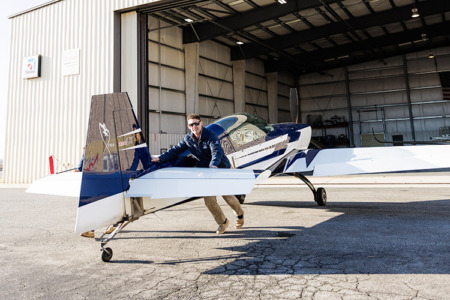
Students first go through three sessions of ground academics to learn about the history of upset and spins and stalls, starting with the Wright brothers’ first flight in 1903, and how the evolution of understanding stall/spin aerodynamics has impacted the safety of flight. They will then participate in three hour-long flights to practice stall, spin, and upset recoveries as well as receive an introduction to basic aerobatics with loops, wing overs, Five Up, Five Downs (five-second inverted climbs and descents), and barrel rolls.
He said the goal is not to train the students to become aerobatic pilots, but to give them the awareness and readiness to respond to being in an unusual attitude.
“If we can put them in what might be ‘unusual attitudes’ for normal everyday flying, then if they inadvertently find themselves in that position later, it wouldn’t be unfamiliar to them,” Dutkus said. “It is all to make sure that when they go out and fly, they are as safe as they can be.”
Dean Steven Brinly said the new simulator and Extra 300 aircraft are major investments into the flight training program, which has experienced tremendous growth, exceeding 900 residential students for the first time.
“Ongoing investments such as these ensure students, staff, and faculty have the resources needed to fulfill the School of Aeronautics’ mission to equip, mentor, and send Champions for Christ into the aerospace community.”