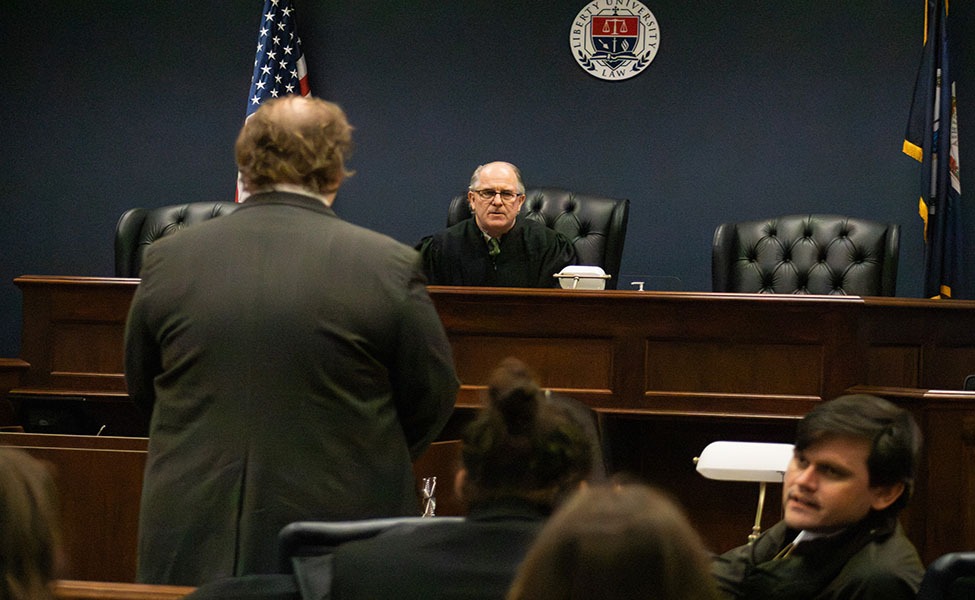
Students at the Liberty University School of Law experienced the criminal justice process as part of a mock investigation event March 12 that was held across several locations including the Hydaway Outdoor Center.
The event demonstrated how a homicide case unfolds. It brought together professors, forensic science students, law students and officers from the Liberty University Police Department to simulate the critical steps investigators and attorneys take when building a criminal case.
The interactive event allowed students to observe — and in some cases participate in — the process that transforms evidence collected at a crime scene into arguments presented in a courtroom.
Andy Hunt, a student on the prosecuting team in the case, enjoyed seeing the process he learned in class put into practice.
“It was really cool to see what the police do in action and kind of how we work with them as a team,” Hunt said. “We read about it in books and other classes, so it was really cool to see it happen for real.”
At first glance, the scene at the Hydaway Outdoor Center looked like the beginning of a real homicide investigation. Yellow crime scene tape surrounded the area while evidence markers dotted the ground. Investigators methodically moved through the scene, carefully examining the surroundings for potential clues.
The first stage of the exercise focused on crime scene investigation. LUPD officers demonstrated how investigators secure and process a scene to preserve critical evidence. Forensic science students observed how evidence is located, documented and collected while maintaining a strict chain of custody.
These procedures are essential, as even small mistakes during this stage can compromise an entire case. Law students watched to understand how a process they normally would not get to see works.
Hunt was surprised by some aspects of the evidence collection process.
“For me there were a lot of moments of ‘should’ve, could’ve, would’ve,’ so I had wished that I had asked some other questions, and now that I’ve had this experience, I know what I would do different next time,” Hunt said.
Students observed how investigators photograph the scene, mark evidence and take detailed notes to create a clear record of what was found and where it was located. According to instructors leading the event, these early steps often form the foundation of the entire investigation.
After the initial investigation, the scenario moved to the Liberty University School of Law, where students explored the legal steps required before investigators can continue searching for more evidence. Law students stepped into the roles of prosecutors and defense attorneys in a simulated search warrant hearing.
Using evidence collected from the crime scene, the students presented arguments before a judge to determine whether investigators had enough probable cause to obtain a search warrant. This part of the process usually only involves the prosecution; however, all students were in the room to understand how the process works. The exercise demonstrated how legal standards guide investigative actions and ensure that searches remain within constitutional boundaries.
On the defense side of the case, student Joseph Hanson said keeping an open mind in this process and not jumping to conclusions is critical.
“It’s very easy to create a preconception of what you think happened and then close your mind to possibilities,” Hanson said. “We see a gun, and we assume somebody shot them. We don’t know that yet.”
Once the mock warrant was approved, the scenario continued to the next phase of the investigation: searching a suspect’s apartment.
On Liberty’s Campus East, officers showed how investigators conduct a careful search of a suspect’s residence. Students watched as officers demonstrated how items are documented, collectedand packaged as potential evidence. From electronics to personal belongings, each item was examined for possible connections to the crime.
This stage illustrated how evidence discovered during a search can strengthen — or sometimes challenge — the narrative investigators are trying to build. For students studying criminal justice, law and forensic science, the demonstration provided valuable insight into the attention to detail required during an active investigation.
The final phase of the exercise brought students directly to LUPD, where officers walked them through the interrogation process. Investigators explained how questioning a suspect can help build a timeline of events and reveal inconsistencies that may lead to further evidence.
Students observed how investigators approach interrogations strategically, balancing investigative techniques with legal protections that ensure suspects’ rights are preserved.
Mary Crossland, a student prosecutor in the case, said it was interesting to see when to step in and when not to and that the mock case gave her confidence for her future legal career.
“I know that going into this I had no idea what to do at all,” Crossland said. “But now I have a better basis and foundation.”
For many students in attendance, the exercise provided a rare behind-the-scenes look at how the justice system operates beyond what can be learned in a classroom.
Organizers say events like this are designed to give students practical exposure to the real-world processes they may encounter in their future careers. By recreating the steps investigators take when responding to a serious crime, Liberty University’s mock investigation allowed students to see firsthand how evidence, law and investigative work intersect in the pursuit of justice.
Phillip Kline, associate professor of law, organized the event.
“The law is inherently a collaborative and multidisciplinary endeavor. Accordingly, engaging students in dynamic settings that require cooperation with professionals from other fields represents one of the most impactful teaching methods available,” Kline said. “I am very appreciative of LUPD and the School of Forensic Science and Professor Mossé for helping make this experience possible for our trial advocacy students.”
According to Kline, this mock process is not finished. Students are now getting ready to participate in a three-day trial from April 8 to 10 that will include expert and fact witnesses. They are looking for volunteers to help at the trial. Students interested in helping can email Kline at pdkline@liberty.edu.
Angelov is a campus news reporter for the Liberty Champion.