English

Study English at a Christian University
Gain access to a wide range of career options with a degree from the Department of Humanities at Liberty University. The ability to read and analyze information, come up with unique solutions, and communicate complex concepts allows Liberty students to succeed in both the marketplace and in life.
Because English is the international language of commerce and diplomacy, the writing and communication skills you learn with an English degree can prepare you for success in the global marketplace.
Whether you plan to be a teacher or work in the journalism, law, or communications fields, let us help you develop the skills you need for life.
Discover Your Passion with a Degree in English
Writing, Editing, and Publishing

Pursue your writing dreams with a degree from the Department of Humanities. Liberty graduates are working in the exciting fields of journalism, television, radio, and publishing. Some are also well-known, published authors.
Teaching

With a B.Ed. in English Education (6-12), graduates can teach English in public, private, and missionary schools, as well as in TESL programs. Graduates can also teach in a university setting with an M.A. in English.
Graduate School

Enhance your career opportunities with graduate studies. After completing your bachelor’s degree, you can get your master’s or doctoral degree through Liberty’s Department of Humanities or further your education elsewhere.
Law School
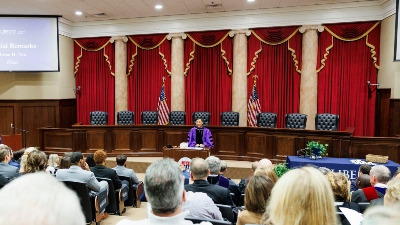
English majors are sought-after law school applicants. Critical thinking skills developed through the analysis and interpretation of literature help English graduates succeed. Excel in a field that requires encyclopedic knowledge, practical skills, and creative problem-solving.
View all English Degrees
- Enhance your degree with an English minor
- Take advantage of resources available at the Residential Writing Center
- Connect with your English Advisor
Featured English Faculty






Start Your Journey as a Student at Liberty
Student Organizations


"Professor Song (Joseph) Cho`s article on the theme of the Promised Land in Harper Lee`s To Kill a Mockingbird has just been accepted for publication in the journal ANQ: A Quarterly Journal of Short Articles, Notes, and Reviews (Routledge)."
Sep 30


And thou, Melkor, shalt see that no theme may be played that hath not its uttermost source in me... he that attempteth this shall prove but mine instrument in the devising of things more wonderful, which he himself hath not imagined.
—Eru Iluvatar, The Silmarillion.
The Silmarillion is J. R. R. Tolkien’s story of how Middle-earth, the setting for The Hobbit and The Lord of the Rings, came into being and of the great legends often alluded to in his other works. In it, we see Eru Iluvatar create Middle-earth with song in concert with the angels, here called the Ainur. Melkor tries to weave in his own theme, which is in discord with Iluvatar’s. It is after this moment that the above quote is spoken.
The entirety of the book hinges on the result of Melkor’s rebellion. Melkor, soon to be Morgoth, has sought the way of pride, and it results in all the sorrows of the world, for he is ever against Iluvatar and his designs, but always he fails and is brought to ruin. Nevertheless, he causes much sorrow along the way, but the sorrow is not the end of the matter. The Silmarillion is told as if from the mouth of a bard in Middle-earth telling the great epics of the past, and in those epics is joy and meaning born of the deeds in the midst of sorrow. In the end, Melkor’s rebellion adds to the beauty and splendor of Middle-earth, and as he is clearly Satan, the same may be said for our world.
Sep 24

What is really original about all of this — and this really is your own exclusive property, much to my horror — is that you condone the shedding of blood on the grounds of conscience.
— Dmitri Prokofich Razumikhin, Crime and Punishment, pg. 313.
Conscience runs like blood all the way through the body of Fyodor Dostoyevsky’s novel Crime and Punishment. It is the impetus for axing an old pawnbroker to death, and it is that which draws a confession from the murderer. Rodion Romanovich Raskolnikov is but a poor former student who murders a bitter, spiteful old woman ostensibly for her money, but it is not as simple as that. The novel is a murder mystery carried not by the question ‘whodunnit?’ but ‘whydunnit?’ As Raskolnikov himself does not seem to know the answer, it has been the subject of much literary interpretation, but conscience is undoubtedly part of the reason.
Raskolnikov grew bitter with his crushing poverty, grew bitter with the injustice he saw everywhere, and deemed he must take action against it. He sought to see if he dared to take a step to better man by stepping over the corpse of a rich pawnbroker for her money so he might use it to do good. All throughout the novel, the times Raskolnikov grows the most bitter are when he is the most helpless, and his best deeds are always in providing for others. He wants to provide for others; he wants to make things better, and he wishes to have the power to do so. His conscience was warped and twisted to fit his pride and desire to be lord, master, and provider to all people, and his inability to be that man ate at him until he fell and sought the means to become what he deemed he must be. He fell and committed the sin of Satan, the sin of pride, and he found himself utterly unequal to the consequences. The conscience which had been abused to drive him to the deed now rent his mind asunder for having done it. In the end, he became yet more helpless and servile until he repented and suffered the Punishment of his Crime.
Sep 17

Contact
DeMoss Hall 4062
(434) 582-2504
EnglishDept@liberty.edu
Connect

