Convocation speaker Tori Hope Petersen shares personal story of choosing life
January 23, 2026 : By Christian Shields - Office of Communications & Public Engagement


Liberty University welcomed best-selling author and Christian speaker Tori Hope Petersen to Convocation on Friday, where she shared her personal testimony of choosing life and caring for the most vulnerable.
The pro-life Convocation message coincided with the annual March for Life in Washington, D.C. About 1,000 Liberty students left campus early in the morning to participate in the march, a longstanding tradition for Liberty.
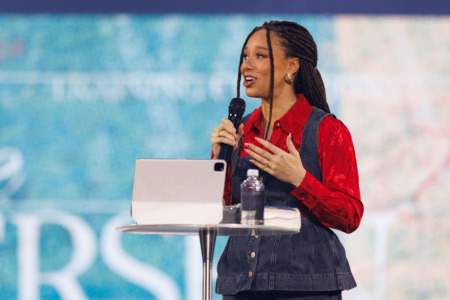
Petersen shared the story of her mother’s decision to choose life for her. When her mother was pregnant with her, she ended up in jail, where she received medical help and was even able to see an ultrasound of her child. Seeing the ultrasound led her to make the decision to carry the pregnancy to term, despite the pressure to have an abortion.
“Because my mom saw past the trauma my biological father caused her, past the pain of her situation, and past the sin committed against her and gifted me with life, my biological mom is and always will be one of my heroes,” Petersen said.
Petersen shared about her experience growing up in poverty as the child of a single mom who never had a true father figure in her life. She was eventually placed into the foster care system, and when she aged out, she moved in with a woman who had cared for her and other disadvantaged youth in the community. While in high school, her high school track coach also began pouring into her and even adopted her.
After high school, Petersen ran track on a full-ride scholarship at a conservative, Christian university. This perceived success, however, began crashing down around her when she discovered during her senior year that she was pregnant. When she told others about her pregnancy, she felt ostracized and lost the support of many self-proclaimed pro-life individuals she had previously considered to be her friends.
Despite the shame and despair she felt in her pregnancy, Petersen never once considered abortion, following her mother’s example.
“Choosing life results in others choosing life,” Petersen said. “My biological mom had abortions before me, and she said she didn’t want to have more because she carried so much regret and so much pain from it,” she said. “Her changing her beliefs from pro-abortion to pro-life broke the generational curse of abortion throughout my family. Because she let her children live, my children live.”
Petersen said she had met others during college who had abortions out of fear of judgment from others. Citing Romans 8:1, she encouraged those who may be in a similar situation to trust in the redemptive power of God.
“If you are a woman in this room who has had an abortion … I just want to apologize. I’m so sorry people weren’t there for you in the way you needed them to be,” she said. “For however much hurt or shame you carry, I want you to know God releases you from it. He forgives you. He loves you. He will heal you. He sets you free. The breaking of generational cycles can start with you. Even if you have already had one, just like my mom, the breaking of generational cycles can start with you.”
Petersen provided students a time of confession to share their own personal struggles with those around them, arguing there is “victory in vulnerability.”
“I am telling the hardest parts of my story because I have learned the more I just share the raw and real parts of it, the more I can help people. That is true for you too. You sharing what is on your heart this morning, it can set you free, but it can also set someone else free.”
Petersen has also used her testimony to pour into the lives of other women, working alongside the woman who had once opened her house to her.
“The redemption of my life was part of God’s plan from the beginning,” she said. “When sin and brokenness entered my life, it was always there. If we truly believe God’s works are wonderful and He writes good redemptive stories from brokenness to beauty, we cannot condone brokenness in any circumstance. We must value life.”
Referencing the stories of biblical heroes such as Esther and Joseph, Petersen argued that God can use anyone to care for others, regardless of their backgrounds or previous hurt they may have experienced. She argued that caring for the vulnerable should be an all-inclusive aspect of following Christ.
“It is nearly impossible to reach a baby at risk of abortion if we’re not willing to serve and love the mom who carries it,” she said. “We think serving the poor, the hungry, the pregnant mom, the unhoused is on one side (politically) and protecting the most vulnerable in the womb is on the other side. But to protect the latter and serve the latter in the womb, we actually have to serve and love the former.”
“We have to be involved in our communities,” she added. “We have to love people at every stage of life — from womb to tomb,” she added. “When we polarize the cause of serving the most vulnerable, when we choose these worldly sides, we lose sight of the command Christ has called us to — that is to love our neighbor and to welcome the stranger.”
Petersen closed with a “family prayer” highlighting the crucial role Christians play in carrying out Christ’s work on earth.
“Christ has no body but yours — no hands, no feet on earth, but yours. Yours are the eyes with which He looks with compassion on this world. Yours are the feet with which He walks to do good. Yours are the hands with which He blesses the world.”