New Chaplains Museum exhibit contains items from Iwo Jima
June 29, 2026 : By Ryan Klinker - Office of Communications & Public Engagement


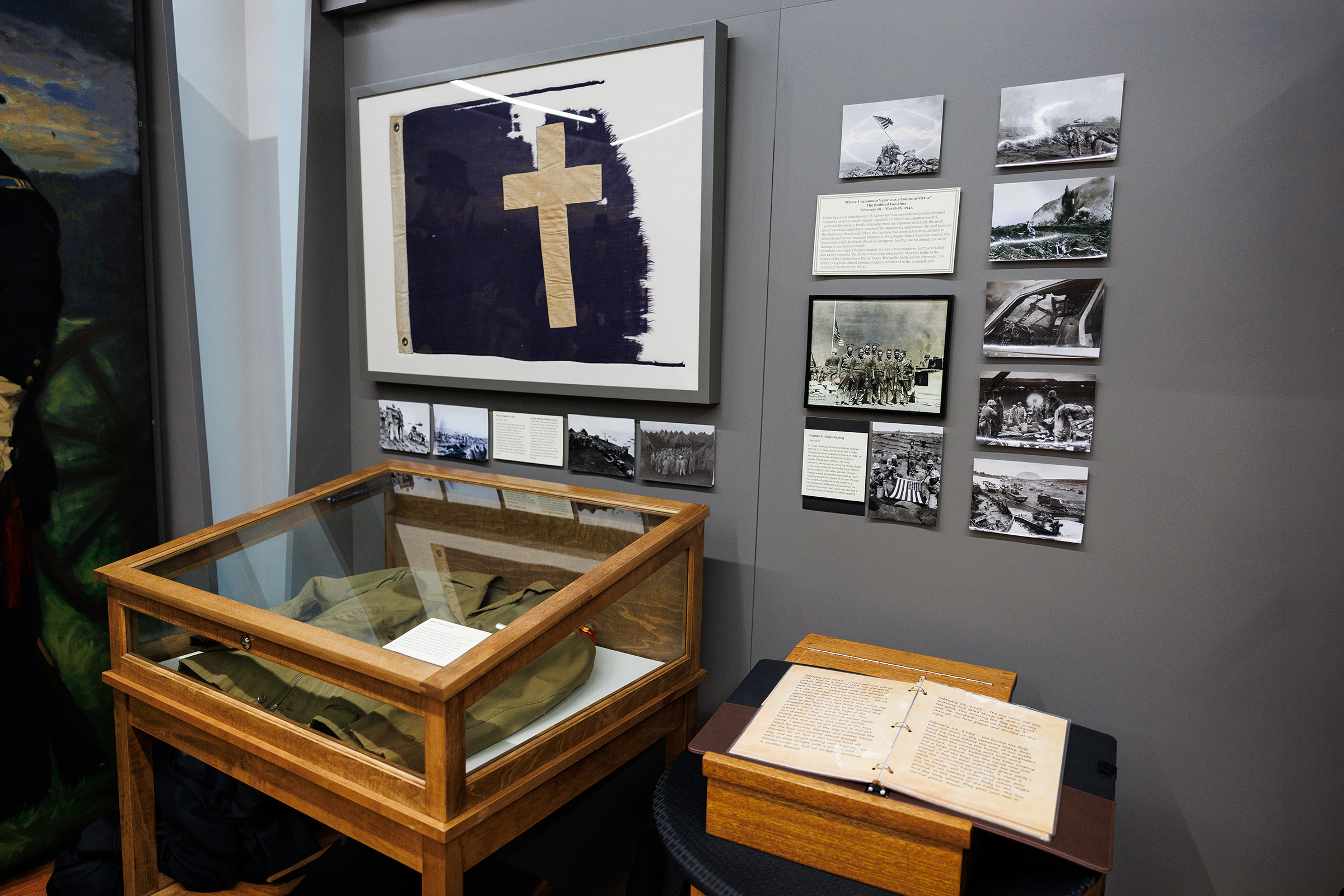
A new exhibit in the Chaplains Museum on Liberty University’s campus was unveiled on Friday, containing a small collection of personal effects from two American chaplains who bravely served their countrymen amid the Battle of Iwo Jima, a landmark battle of World War II.
The battle was characterized by 36 days of fierce fighting between U.S. Marines and the Japanese Imperial Army, leading to heavy casualties on both sides. The chaplains were frequently giving last rites to those killed, sometimes doing so while under fire themselves.
The display, which includes a chapel flag, a field jacket, chaplain materials, photographs, and excerpts of a journal, highlights two of the approximately 60 chaplains who served at Iwo Jima: Archie William Wallace Gray from the U.S. Army’s 232nd General Hospital Detachment and E. Gage Hotaling from the 4th Marine Division’s Graves Registration Service. The unveiling included brief speeches by College of Arts & Sciences interim dean Dr. Samuel Smith, Department of History professor Dr. David Snead, and members of Liberty’s Center for Chaplaincy from the John W. Rawlings School of Divinity.
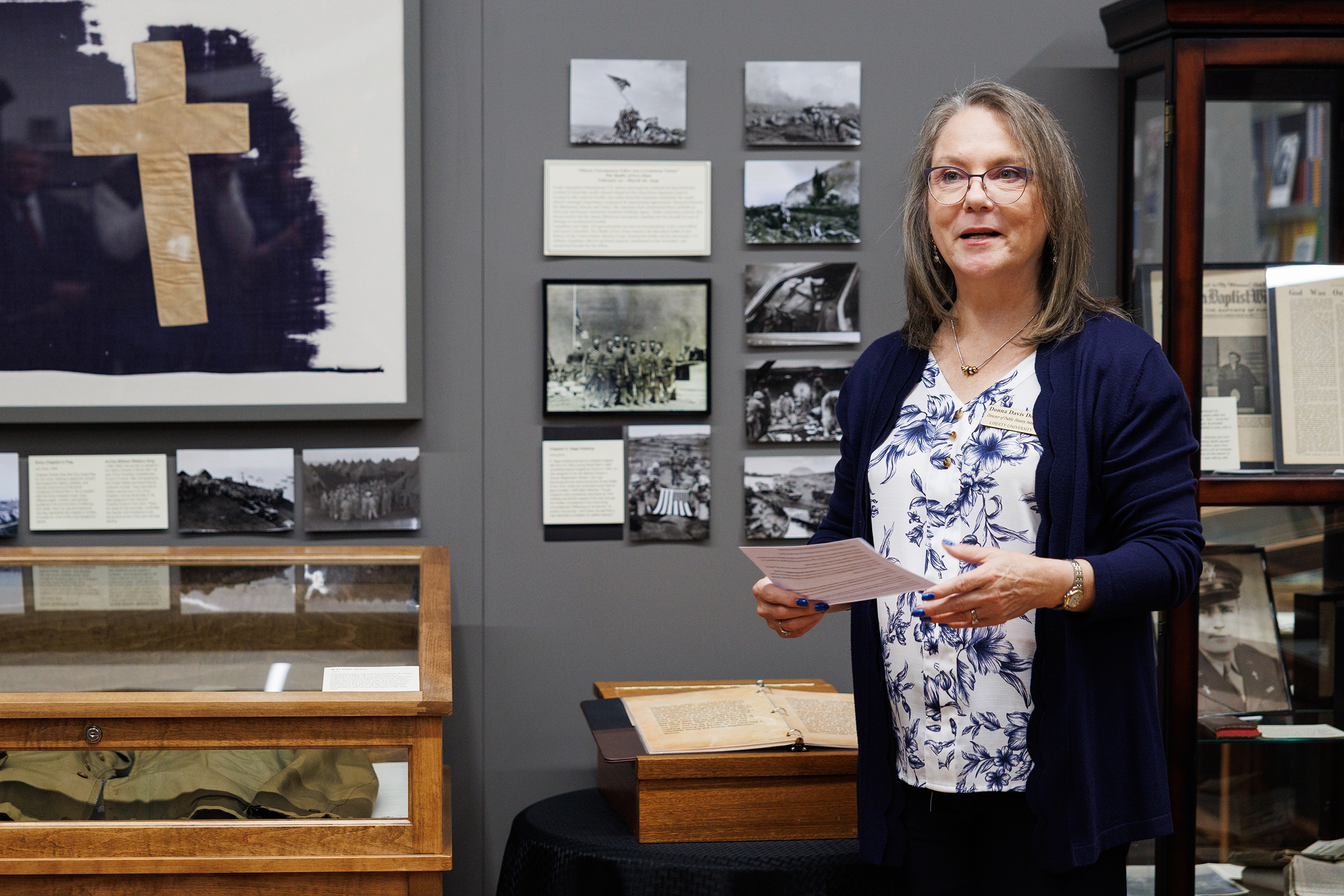
A flag with a white cross on blue fabric once flew outside the makeshift chapel of Chaplain Gray, who landed on Iwo Jima on Feb. 19, 1945. Gray was a native of Canada and also a veteran of World War I, fighting in trenches as a member of the Canadian Expeditionary Force in France. He later emigrated to the United States and became a citizen. To this day, the flag bears traces of the ash found on the volcanic Pacific island. As Chaplains Museum director Donna Davis Donald, Liberty’s director of public history initiatives, mentioned during the unveiling, those who have already seen the flag note that while the flag is noticeably tattered in some areas, the cross at its center is fully intact.
Following Gray’s return home from the Pacific, the flag was stored in a cedar chest along with a collection of other items from his time as a chaplain. When Gray died in 1963, the chest was given to his son, Neil, who kept it for decades until 2025, when he searched for a place where his father’s belongings and legacy could be displayed. He sent the flag and his father’s stole to the Chaplains Museum last summer. Neil Gray has since passed away.
In receiving Gray’s items, Donald began searching for other chaplains from Iwo Jima who could be featured in a larger exhibit. At the same time, Eliana Bricker (’26), who was earning her bachelor’s in history and taking a summer archaeology intensive under Donald at the time, heard about the possibility of doing Iwo Jima research and jumped at the opportunity.
“I’ve always been really interested in Iwo Jima and East Asian history in general, and I was also planning on doing some CSER (Christian/Community Service) with the museum for the summer,” Bricker said. “When (Donald) got an email that said that they were receiving the chaplain’s flag from Chaplain Gray from Iwo Jima, I asked if I could be a part of this project.”
Through her research, she was able to fulfill her CSER credit and a public history course credit at the same time.
“This experience has really opened my eyes to the idea that I can have a career in history, what that would look like, and how fulfilling it could be for me,” she added. “It’s given me a lot of confidence, it has really changed my outlook on my major, and it’s become something that I really want to do.”
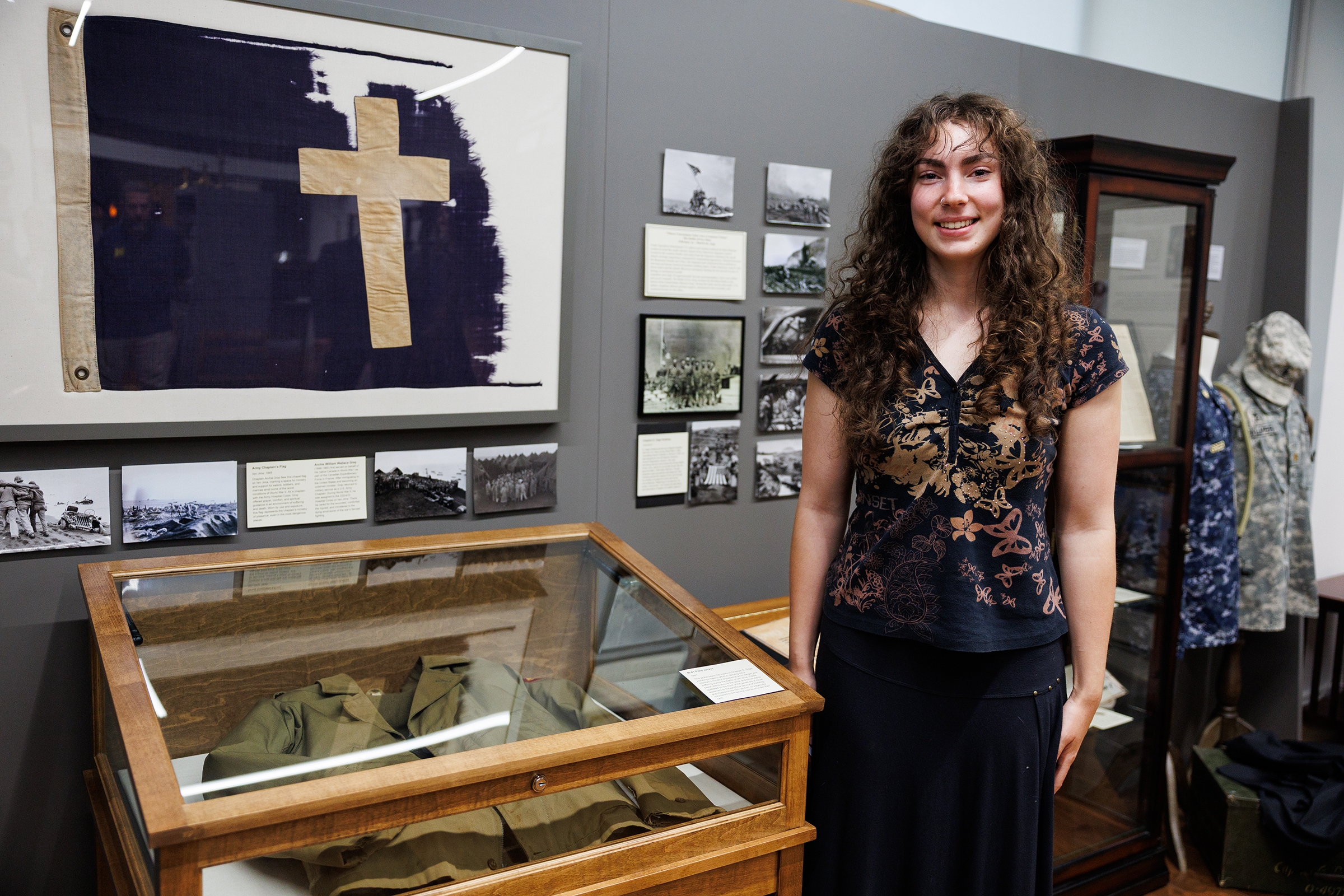
Bricker came across excerpts from the journal of Chaplain Hotaling, who had passed away in 2010, and a book about him written by his son, Kerry Hotaling. A few weeks after the museum reached out to him, Kerry Hotaling sent them a field jacket, a chaplain kit, and a transcribed version of his father’s journal. Besides doing additional research on the jacket and the context of Hotaling’s journal for the exhibit, Bricker created a binder with journal excerpts for guests to read.
The exhibit is now open in a section of the museum titled “Service on the Battlefield,” which honors chaplains from the Revolutionary War up into more modern conflicts.
“The goal is to continue to pursue our mission of helping people understand the unique contribution of chaplains, and the extent of their service and sacrifice,” Donald said. “It is really interesting to see the number of people who come in and are completely unfamiliar with the concept of a military chaplain, and we’re able to explain that important role. Many chaplains are evangelical, Bible-believing Christians, and they are able to use that platform to share the Gospel, and we see lives transformed because of it. We have dozens and dozens of those types of stories in the museum.”
“The other thing that I think is unique about our museum, and this exhibit contributes to that, is the role of students,” Donald added. “If we hadn’t had Eliana as a student volunteer, I wouldn’t have all the material we have now. We had a chaplains panel at the “America’s Founding: Legacy and Influence” conference (held on Liberty’s campus in April), and four students had completed papers based on material that was from the museum.”
Bricker said she hopes the Iwo Jima exhibit will highlight the true dedication and bravery of chaplains, who are sometimes overlooked.
“One of our big themes for the museum is talking about the chaplain military service and how they were on the battlefield too,” she said. “Chaplains had a tendency throughout history to be somewhat pushed aside or treated like they’re soft because they wouldn’t carry weapons, but it’s really important to note just how much they were doing. Chaplain Hotaling helped to orchestrate about 1,800 funerals on Iwo Jima. In his journal, he talks about the sacrifices that he has made and how his sacrifice wasn’t any less just because he was a chaplain.”
The Iwo Jima exhibit is one of the museum’s first digital exhibits available online.
The Chaplains Museum, located on the terrace level of the Jerry Falwell Library, is open this summer on Mondays, Thursdays, and Fridays from noon-4 p.m. and on Saturdays from 10 a.m.-2 p.m. This fall, hours will be Monday through Friday from noon-4:30 p.m. and Saturday from 10 a.m.-2 p.m.