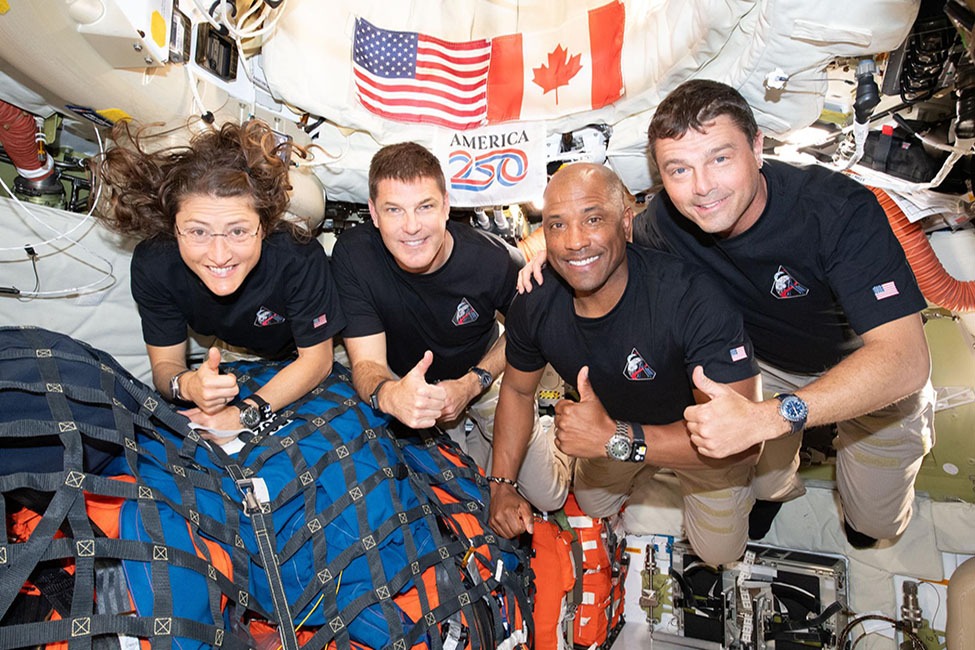
The crew of Artemis II completed a successful mission around the moon Friday, April 10 as their Orion capsule splashed down off the coast of California.
The purpose of this mission was primarily to test life support systems and navigation to prepare for future crewed lunar landings, according to NASA. Teams back on Earth will use data gathered during the mission to “better understand the effects of deep space — such as microgravity and radiation — on crew physiology, immune response and performance” to aid future crewed missions to the moon.
NASA Commander Reid Wiseman, Pilot Victor Glover, Mission Specialist Christina Koch and Canadian Space Agency Mission Specialist Jeremy Hansen also broke Apollo 13’s record of 248,655 miles for the furthest distance any human has been in space. Artemis II reached 252,756 miles from Earth on April 6.
Upon reaching this milestone, Hansen challenged current and future generations during NASA’s livestream to not let their record last long.
“As we surpass the furthest distance humans have ever traveled from planet Earth, we do so in honoring the extraordinary efforts and feats of our predecessors in human space exploration,” Hansen said. “But we most importantly choose this moment to challenge this generation and the next to make sure this record is not long-lived.”
Before the Artemis II crew, the last time humans laid eyes on the far side of the moon was during the Apollo 17 mission in December 1972 — nearly 54 years ago.
While viewing the far side, the Artemis crew took the opportunity to suggest naming two unnamed craters. They suggested naming one Integrity, after their spacecraft. They requested the other be named Carroll, in honor of Wiseman’s late wife, Carroll Wiseman, who died of cancer in 2020.
While conducting the mission, the crew also photographed the far side of the moon during their lunar flyby on April 6, showing regions not seen by human eyes before. They also witnessed a solar eclipse and reported seeing six meteoroid impact flashes on the lunar surface, NASA reported. Photos of the Artemis II mission, including those taken during the lunar flyby, can be accessed on NASA’s multimedia resources page.
In a CBS News interview, Glover expressed his admiration of the beauty of God’s creation.
“I think these observances are important, and as we are so far from Earth and looking back at the beauty of creation, I think … one of the really important personal perspectives that I have up here is I can really see Earth as one thing,” Glover said. “You are special in all of this emptiness, … this thing we call the universe. You have this oasis — this beautiful place that we get to exist together.”
In one of the last and biggest obstacles of the mission, the Orion crew capsule reentered Earth’s atmosphere on Friday traveling 35 times the speed of sound, according to NASA. Intense heat and plasma caused an expected communications blackout for about six minutes.
Seven minutes after reestablishing communication, the crew safely splashed down off the coast of San Diego, California.
President Donald Trump posted on Truth Social soon after the splashdown, congratulating the Artemis II crew and expressing excitement at their upcoming visit to the White House.
“I look forward to seeing you all at the White House soon,” Trump said. “We’ll be doing it again and then, next step, Mars!”
Glover was also asked by CBS News if he had a message to share about Easter Sunday.
“I think as we go into Easter Sunday, thinking about all the cultures all around the world — whether you celebrate it or not, whether you believe in God or not — this is an opportunity for us to remember where we are, who we are and that we are the same thing and that we got to get through this together,” Glover said.
As for future missions, Artemis III, which is scheduled for 2027, will test one or both landers from SpaceX and Blue Origin. NASA plans for Artemis IV to land on the moon in early 2028.
For more details on the Artemis program, visit nasa.gov/humans-in-space/artemis/.
Photo credit: NASA.
Davis is an off-campus news reporter for the Liberty Champion.