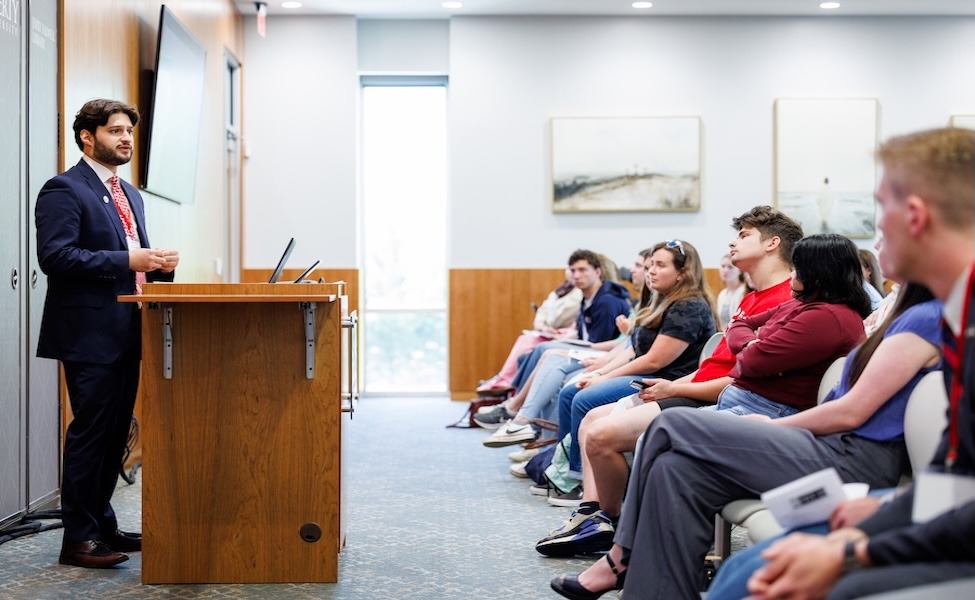
The Jerry Falwell Library hosted Research Week from April 20 to April 23. Research Week is a four-day event dedicated to student research presentations. Students from departments across campus and online presented their research through posters and oral presentations.
Angela Rice, dean of the Jerry Falwell Library, spoke at the opening ceremony Monday morning. She said Research Week 2026 was the largest yet hosted by Liberty University, surpassing last year’s. The poster presentations, which used to be held in the JFL, outgrew their space and were moved to the Montview Alumni Ballroom.
“I think last year I had said that this is the largest research week yet, and 2026 is that as well,” Rice said.
Rice emphasized the beauty of the variety of topics being presented throughout the week.
“You’ll hear student scholarship revealing the wonder of God’s creation, and we know that all knowledge and truth are God’s. And through these students’ hard work …, we can have a better glimpse of God’s miracles in creation,” Rice said.
Jeremy McGinniss is the associate dean for research instruction and collections at the JFL and oversees Research Week. He said that Research Week is unique to Liberty due to its interdisciplinary nature. It allows for a breadth of opportunity for students.
“Any practice of standing up in front of people and talking and communicating about your ideas is great practice in anything you’re going to do. There’s some very practical career opportunities (in the experience), but also just the practice of developing communication skills is valuable really for anyone,” McGinniss said.
McGinniss said Research Week offers students a platform to communicate their ideas to a larger audience.
Oral presentations were presented in-person by residential students and via Teams by LUO students. One such presentation was given by online student Francisa Atem. She presented “A Comparative Analysis of Cognitive and Social Outcomes in Toddlers with Speech Delay (SD) Versus Autism Spectrum Disorder (ASD).”
Two judges watched the presentation and examined Atem afterward. A group of students who attended asked Atem their own questions after the judges.
First-year doctoral student Vionnah Githira said the presentation helped her understand what dissertation research looks like.
“That gives me a bird’s-eye view of what to expect down the road,” Githira said.
Ashley Wray, also a first-year doctoral student, has done research regarding children with autism. She expressed anticipation for seeing the results of Atem’s presentation.
“It was really interesting seeing how she’s going to conduct her research,” Wray said.
Another oral presentation was given by online student John Fischer. He spoke on “Redefining the Synoptic Gospels Problem.”
The poster presentations showcased student projects in visual formats meant to clearly illustrate the research questions, analyses, findings and recommendations for future work acorssvarious disciplines.
One such poster was presented by first-year graduate student Daniel Murphy. He presented on the topic, “The Power of Cult Rhetoric.” He said he has always been drawn to documentaries about cults and is fascinated by the reasons why people join them.
He said he will be required to write a thesis for is master’s program, and his presentation on cult rhetoric is part of that ongoing research project.
“Part of the research we’re looking at, like testimonies and documentaries from former members … so people who were actually in them and got out,” Murphy said. “This theory is the idea that people will adopt beliefs and ideas in the group that they’re associated with. People pretty much turn into a different person when they’re in a cult group.”
Randy Litman, associate dean for clinical affairs and graduate medical education, was a judge for the poster presentations. He said his specific role was to judge presentations for originality, depth of research and methodology. One commonality among student presenters, he said, was their passion for their topics.
3MT (Three Minutes Thesis) presentations took place Thursday at 1 p.m. and were based on a competition started by the University of Queensland, Australia. These brief presentations gave undergraduate and graduate students a chance to present summaries of their research in three minutes or less in front of an audience and judges.
The audience had ballots listing a total of 31 students to vote on for the People’s Choice Awards for undergraduate and graduate students.
In addition to the presentation, the Media Wall in the JFL atrium showcased Juried Arts presentations from student artists.
The winners of each category, for undergraduate and graduate students, will be announced May 6 at 10:30 a.m. during the Research Week Awards Ceremony held in the JFL lower atrium. For more information on Research Week, visit liberty.edu/library/research-week/.
Danilson is a campus news reporter for The Liberty Champion