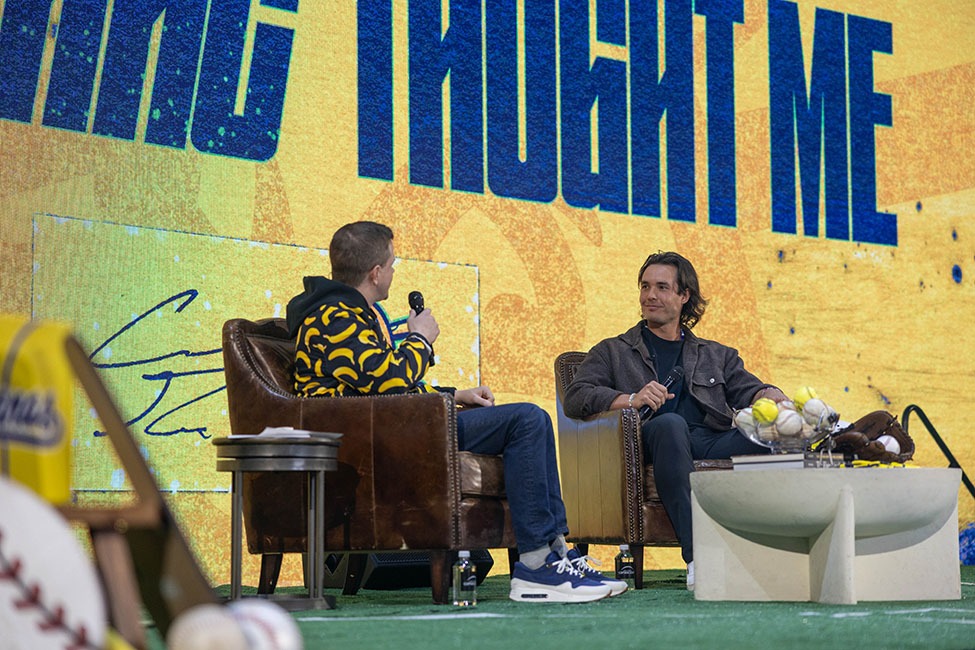
Liberty University students gathered for Convocation Wednesday, April 8, and Friday, April 10, hearing from Savannah Bananas outfielder Coach RAC and members of the Bible Caddie Podcast. Each Convocation centered on identity and the pursuit of a life rooted in Christ rather than performance and success.
Wednesday’s Convocation featured RobertAnthony Cruz — widely known as Coach RAC — a left fielder for the Savannah Bananas and social media content creator who shared his journey through baseball, identity struggles and spiritual growth.
As a student-athlete at the University of California, Riverside, he described how his sense of worth became heavily connected to how he performed on the field. That pressure eventually led him into a season of reflection about where his true identity came from.
“I feel like so much of my identity is wrapped up in how I perform on the field, and that identity should be more of how God sees me and not how other people see me,” Cruz said. “That kind of began this whole journey for me throughout college of seeking to have my identity in Christ and not in how I perform on the field.”
That realization marked a turning point for him. As Cruz transferred to Biola University, he began intentionally pursuing a Christian community and deeper spiritual formation, which reshaped how he viewed both faith and life.
“I started craving community,” Cruz said. “I know that I need to be spiritually connected to the body if I want to grow and have my identity truly rooted in Christ.”
What followed was a growing understanding that spiritual growth was not meant to be isolated but lived out in connection with others.
Cruz shared that one of the most defining shifts in his mindset came when he reframed failure itself. Instead of striving for perfect outcomes, he learned to accept imperfection without losing his sense of worth.
“I didn’t need to envision myself succeeding all the time; I needed to envision myself failing and being okay with it,” Cruz said. “I needed to realize that God still sees me as his beloved child, regardless of whether or not I make the throw.”
After being signed by the Washington Nationals and later released, Cruz entered a period of uncertainty but also clarity.
“The most fulfilling thing for my soul was not even achieving the dreams that I hoped to achieve,” Cruz said. “The most fulfilling thing for my soul is just getting to do life every day with a God who loves me.”
Throughout his testimony, Cruz emphasized that while pursuing dreams is important, they cannot be the foundation of identity. Instead, he pointed students toward a life anchored in purpose, calling and faith.
Friday’s Convocation, featuring Webb Simpson, Ben Crane and William Kane from the Bible Caddie Podcast, came just in time to watch the Masters Tournament. As a podcast that combines golf banter and Bible study, the panel explored a central question: What will you live your life for?

Kane opened by emphasizing that this question is not just theoretical; it is something students are already answering through their daily decisions and priorities.
Using Ecclesiastes 2 as a framework, the panel walked through the various places people often look for fulfillment, including social life, accomplishments, wealth, entertainment, sex and approval. Each category reflected not only Solomon’s experience but also the patterns seen in modern culture.
Kane shared candidly about his own pursuit of what he thought would bring satisfaction, only to find it ultimately empty.
“I thought that the good life was that my life would look like a rap video,” Kane said. “I had gotten everything I wanted, and it didn’t deliver at all.”
That sense of disappointment was echoed by Simpson, who described a defining moment in his collegiate golf career. After achieving a major goal, instead of the fulfillment he expected, he encountered something more.
“What I had put out there was a hope in my heart of winning the ACC Championship,” Simpson said. “I did it and did it even further than I imagined. And similar to William’s feeling in Miami, I had this emptiness that I couldn’t put my finger on.”
Together, their experiences highlighted a central theme that success — even at the highest levels — cannot carry the weight of identity or provide lasting satisfaction.
The panel expanded on this idea by pointing to well-known figures who have reached the pinnacle of success yet still experienced the same emptiness.
“If it didn’t work for Solomon, and it didn’t work for Tom Brady, and it didn’t work for Tiger Woods, is it really going to work for us?” Kane said.
Rather than leaving the question unresolved, the panel pointed students toward a different answer: one found in Jesus’ invitation in Matthew 16. According to Kane, the good life is not discovered through accumulation or achievement but through surrender.
“The way you find your life is going all in with Jesus Christ,” Kane said. “There’s this sweet promise that if we’ll lose our life for Jesus’ sake, then we’ll find it.”
The discussion concluded by reframing what it means to follow Christ. Instead of presenting it as an obligation, Simpson emphasized it as something far more meaningful and transformative.
“Jesus is an invitation,” Simpson said. “It’s not a duty; it’s a delight to follow him.”
Both Convocations pointed to the same truth that identity built on performance or success will not last. Instead, students were encouraged to find lasting purpose and fulfillment in Christ rather than in what they achieve.
Clardy is the off-campus news editor for the Liberty Champion.