From battlefield ministry to protecting religious freedom, military chaplains have played an important role in the lives of service members throughout American history.
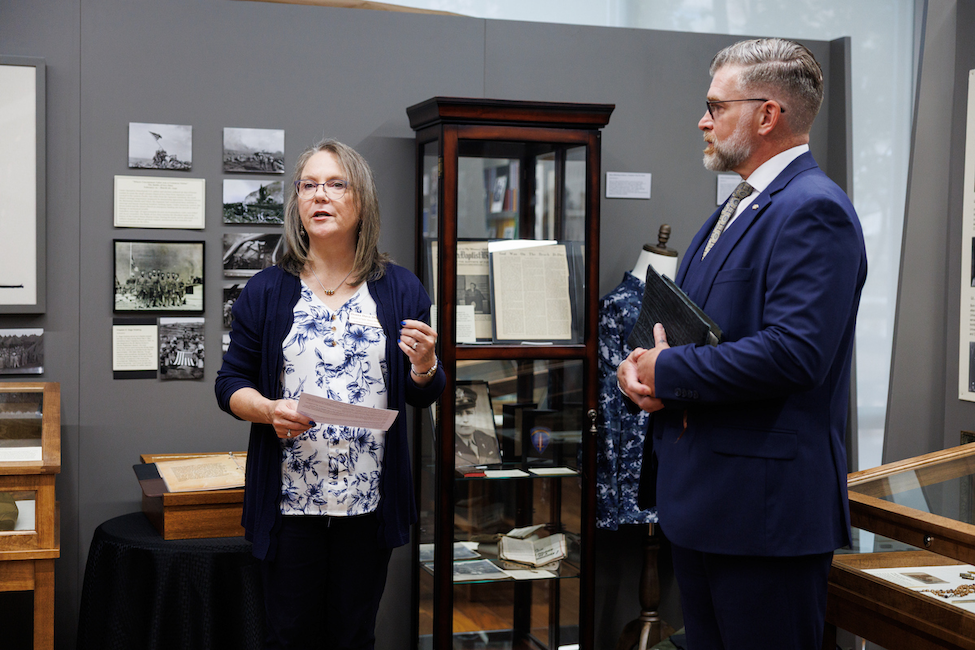
At Liberty University, the Chaplains Museum preserves that history while providing students with hands-on experience working in a professional museum setting.
The museum was founded in 2005 when Kenny Rowlette, a former Liberty literature professor and Civil War history enthusiast, gathered individuals interested in telling the story of Civil War chaplains. The group began collecting artifacts and historical materials, initially displaying them in the professor’s office before eventually receiving a dedicated space.
According to Director of Public History Initiatives Donna Donald, in 2012 the museum became part of Liberty’s academic program. Originally housed within the history department, it is now part of the Department of Humanities. Before 2020, the museum operated entirely through volunteers, but now the museum is staffed by student workers.
“The unique thing about this museum is that it is a student laboratory,” Donald said.
Although many students involved are history majors, the museum has also provided opportunities for others across different programs.
“We’ve done internships and special projects and things like that for a lot of academic majors,” Donald said. “We have a soundtrack that was created by a music production student and a major exhibit area done by an interior design student.”
The museum’s mission has two focuses: preserving the history of military chaplains and providing students with professional experience.
“Our mission is to preserve and perpetuate the memory of the work of military chaplains,” Donald said.
Military chaplains provide spiritual care to service members, often accompanying them into challenging environments rather than remaining at military headquarters.
“They carry out a ministry of presence … which means they go where the soldiers, sailors or Marines are,” Donald said. “They don’t sit back at headquarters or at the base and wait.”
One of the museum’s most notable exhibits features artifacts belonging to Chaplain Calvin H. Garner, a Baptist chaplain who served during the Vietnam War. His display features his field jacket, chaplain’s kit, communion kit, photographs and sermon notes, which were all provided to the museum by Garner’s family.
Another exhibit highlights chaplains who served during the WWII Battle of Iwo Jima. A flag donated by the son of Army Chaplain Archie William Wallace Gray, who served in the hospital unit of Iwo Jima, is displayed alongside a field jacket belonging to Chaplain E. Gage Hotaling.
Donald said Hotaling presided over the burial of approximately 1,800 Marines while serving in Iwo Jima. The museum also displays a portable organ acquired through a grant from the John and Blanche Steinhoff Memorial Fund. The instrument allowed chaplains to bring music into military settings where traditional worship services were unavailable.
“This shows the ministry of presence. They go where the men are,” Donald said.
According to Donald, the museum attracts visitors from all over, many who visit while passing through the area of visiting Liberty’s campus.
Donald said the museum continues expanding its collection while working toward increasing its digital content.
“Even if you don’t know anything about chaplains … we still have some pretty interesting stories to tell,” Donald said.
Daniel is a feature reporter for The Liberty Champion.