Newly hired Flames Football Dietitian impacts her athletes through one message
Social media is a loud and demanding force that captivates the attention of many students aged 18-22, feeding them an alluring message: eat to look your best.
True nourishment is often confused with the concept of looks-maxing, leaving a generation to believe that high-protein, low-carbohydrate diets are the key to health and performance.
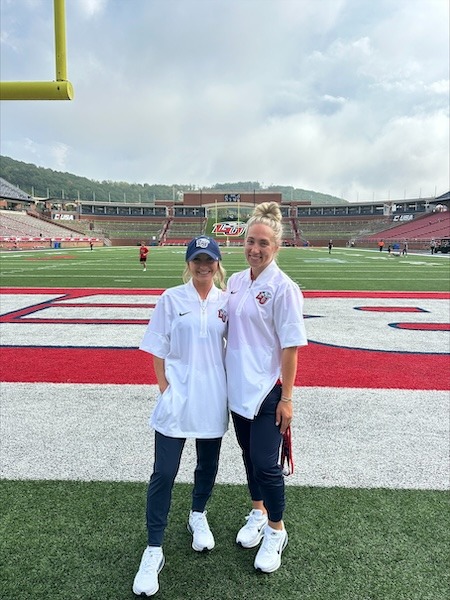
The Flames’ Assistant Football Dietitian, Samantha Bernhardt, joined the Liberty Flames Football team this summer and has dedicated nearly a decade to studying nutrition. She has worked with everyone from high school athletes to ultra-marathon runners.
“When you try to fit into the box social media makes you fit into, that’s when you get hurt,” Bernhardt said. “The Lord created all this food, and it is good, until it’s twisted by the world.”
Bernhardt’s passion for the field began when she was a little girl. Growing up with brothers who enjoyed sports, she was immersed in their world and became particularly drawn to football.
“My love for football … there’s just something about the football culture that is family,” Bernhardt said. “That’s everybody’s ‘why’ when you get down to it. You can’t do football independently. It’s a really sweetspace that reflects life so well.”
Bernhardt’s passion became using food to serve others, only after she saw her mother do the same.
“My love for nutrition came from my mom’s love for cooking and observing how that brought people together,” Bernhardt said.
Fusing the two worlds, Bernhardt pursued a master’s degree in sports nutrition at The Ohio State University. Today, she uses that knowledge to serve Flames Football.
Her journey to Liberty was not one she initially expected. After beginning her career in medical practice, she worked with a variety of clients such as lacrosse and basketball players, marathon runners, ultra-marathon runners and members of the general population. While she enjoyed the experience, something was missing.
“I missed the speed of football,” Bernhardt said.
Initially, she thought stepping away from football would provide her with more time to spend with family. Despite this, she felt God was leading her in a different direction.
“I thought I wanted more of a work-life balance,” Bernhardt said. “The Lord reminded me, like, that’s what the world tells me I want. But he put a big passion for football in my heart.”
From 6:15 a.m. to 4 p.m., her days fall into a steady rhythm: fuel, hydrate, prep, repeat.
She begins her day by preparing pre-practice fueling tables stocked with supplements such as beetroot, collagen, pickle juice, quick carbohydrate snacks and protein shakes for players who struggle to eat early in the morning.
During practice, she manages hydration stations and carbohydrate replenishment. After practice comes recovery nutrition, followed by lunch service, fueling stations for athletes lifting weights and protein shakes to aid recovery.
The afternoon is spent stocking the fuel zone, an area for athletes with drinks and snacks to give them the energy they need, preparing supplements for the following day and finding ways to create enjoyable nutrition options for players before wrapping up with staff meetings.
As a sports dietitian, Bernhardt faces the challenge of helping student-athletes make informed nutrition decisions in an era when social media feeds are flooded with diet trends, making it difficult for science-backed advice to compete with viral nutrition content.
“Your feed is whatever the influencers are doing. But nutrition is not a one-size-fits-all, especially when it comes to athletes,” Bernhardt said. “You’re not the same as just the general population. Your body needs so many more carbohydrates, but I think it’s hard to differentiate yourself.”
Bernhardt believes social media can make it difficult for athletes to separate performance goals from appearance goals.
“Obviously in sports there’s body dysmorphia for girls and guys,” Bernhardt said. “You want to perform your best, but then you’ve got the world telling you to look your best. So you can change one thing and lose sight of the other. We’re trying to give them the perspective they need while also having empathy that we all fall to those trends.”
Bernhardt says the carb-cutting trend is something she has seen on the rise for years, while newer concerns surrounding protein consumption and seed oils continue to gain traction online.
“There is an over-protein of everything,” Bernhardt said. “I’m sorry, but the protein’s not going to get you very far.”
In a digital culture crowded with diet trends, fitness influencers and conflicting nutrition advice, Bernhardt hopes student-athletes learn to tune out the noise and focus on what their bodies need.
For her, nutrition is not about chasing a certain look or following the latest viral trend. It is about stewardship, performance and giving the body the fuel it needs to thrive.
“Fuel for the work you could do, refuel for the work that you did,” Bernhardt said.
In a world constantly telling students what they should eat to look their best, she hopes they instead learn to eat with a purpose.
Potter is a sports editor for The Liberty Champion.