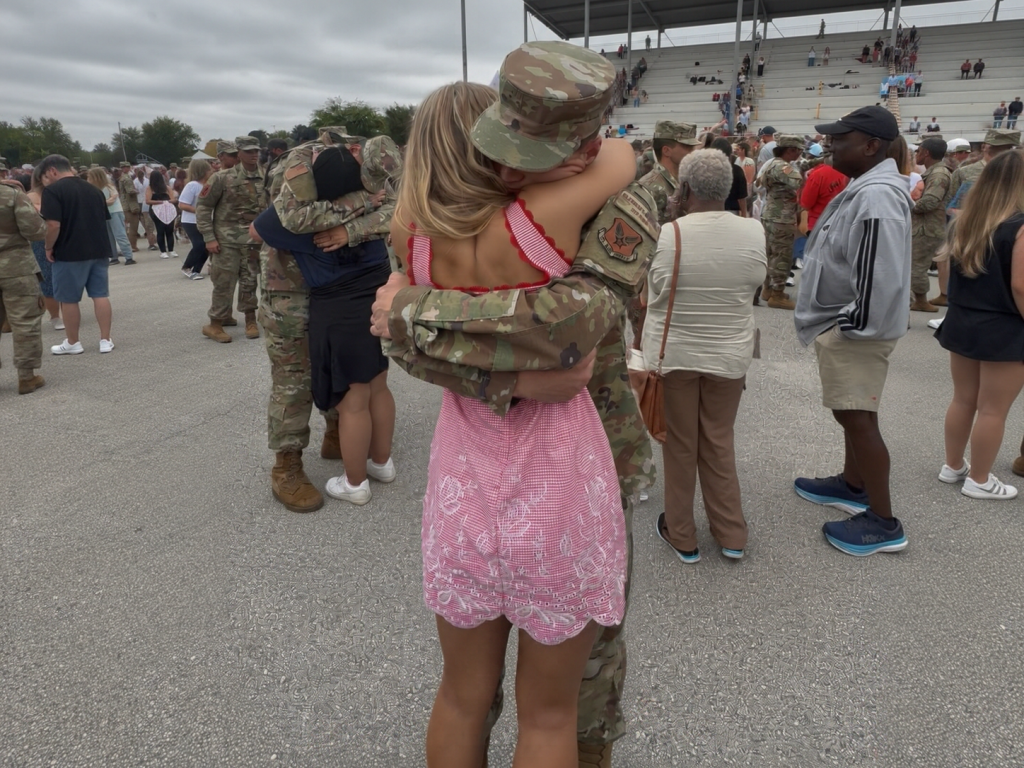
A moment you will never forget, if you have the opportunity to experience it, is seeing the name of a loved one pop up on your phone screen after weeks without contact.
Military service is often recognized through ceremonies, deployments, routines and uniforms worn by those who took an oath to serve our country. However, behind every service member is a support system of people who experience their own version of military life.
Children, parents, significant others and spouses of service members must learn to navigate distance, uncertainty and sacrifice while coping with the reality that they may not always be able to see or communicate with a loved one.
While service members carry the responsibility of serving their country, their families carry the responsibility of keeping life moving at home in their absence.
Supporting someone in the military often means learning to celebrate milestones from a distance. Anniversaries, birthdays, holidays and even the small, everyday moments of life can look very different when loved ones are away for training or deployment.
The excitement of receiving a phone call or text message becomes a lifeline to hold on to, never knowing when the next opportunity to communicate will come. Families learn to manage uncertainty by holding on tothe hope of the next conversation to come.
I myself have a significant other who serves in the U.S. Air Force. During the week he left, I experienced a feeling I had never known before that occurs when people miss their loved ones so deeply while having no way to communicate with them and not knowing when they will hear from them again.
Thankfully, I had the opportunity to ask Liberty University President Dondi Costin and his wife, Vickey Costin, to pray with me and offer advice on how to navigate this season of life.
They told me that being a support system for someone who serves our country is a calling of its own. Although it may feel as if no one understands the sacrifices being made — and they may not — there is a light at the end of the tunnel. God does not call the equipped — he equips the called.
Military romantic relationships require patience and trust because communication is not always an option. Supporting a service member often means taking on additional responsibilities while your partner is away, balancing your own education, career and personal life, all while continuing to encourage and pray for the one serving.
However, this experience is not one exclusive to romantic relationships.
Children with military parents grow up with a different understanding of time and family. Some experience milestones without a parent present, become familiar with making new friends because of frequent moves or learn to adjust to unfamiliar environments.
A child’s perspective on having a parent in the military may differ from an adult’s, but the emotions surrounding the experience are just as significant.
Parents also experience the sacrifices of military service from a different perspective. Watching a son or daughter leave home to serve their country can bring a mixture of excitement, pride and concern. Parents support their child’s decision while coming to terms with the reality that it may take them far from home and into potentially dangerous situations.
Despite their different experiences, these family members share one responsibility: being a source of encouragement for their loved ones and for others in a similar situation.
Being part of a military support system also means you have to understand that the challenges of military life do not disappear when a service member returns home. Reconnecting after time apart, adjusting to new routines and navigating the transition between military and civilian life can require patience from everyone involved.
The military support system extends beyond the immediate family of a service member. Friends, churches and communities can offer encouragement, prayer and a sense of belonging to those navigating this experience.
Ultimately, military service is about more than the men and women wearing the uniform. It is also about the people who stand behind them, pray for them and encourage them through everything.
Behind every service member is a family serving in their own way.
Sizemore is the POV editor for The Liberty Champion.