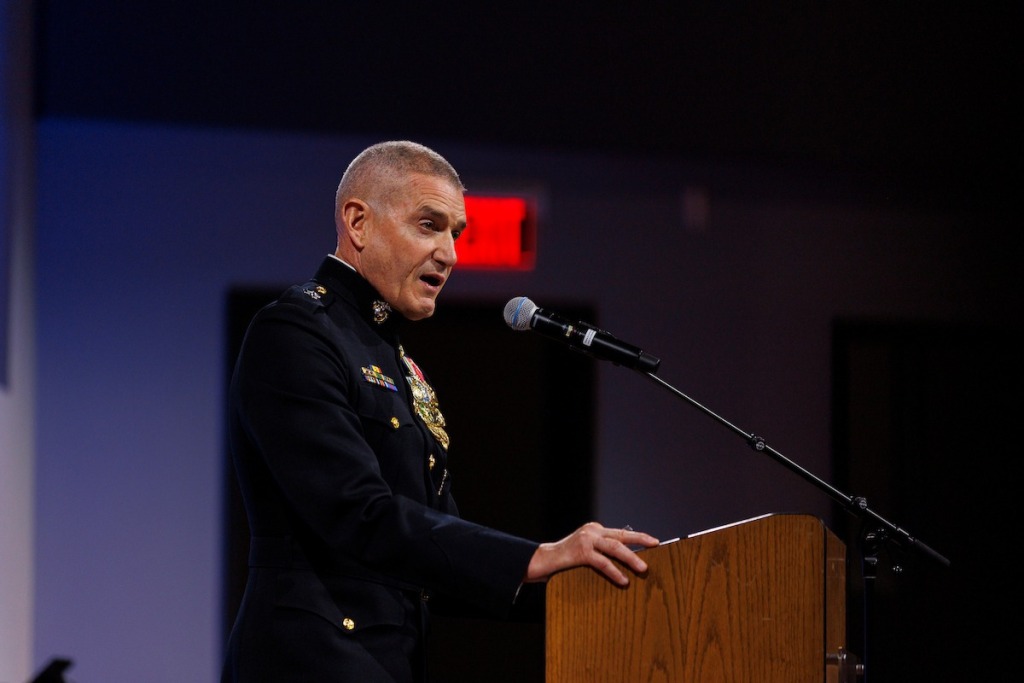
Before Maj. Gen. Jason Bohm began serving as the dean of Liberty University’s Helms School of Government, he served 34 years as an active-duty Marine.
As a young major for the U.S. Marine Corps, Bohm sat in his living room feeling crushed by the weight of responsibilities and expectations. He worked daily to meet a quota for recruiting future Marines — asking each young recruit, and their family members, if they were willing to dedicate themselves to a life of selfless service to their country.
The weight of this job was too much to bear alone, and a young Bohm looked up to the ceiling in prayer.
“God, I cannot do this on my own any longer,” Bohm said. “I’m putting my life in your hands. I surrender to you.”
In that moment, the weight completely lifted off his shoulders.
The next day at church, Bohm found a pamphlet titled, “The Book of Hope.” He turned to a page, which happened to be about perseverance. The pamphlet said trials in life provide an opportunity for spiritual growth.
“I started seeing and hearing God operating in my life like I never had before,” Bohm said. “It was incredible. And so, the little things, the little stressors, the irritations of life no longer mattered. It was now God being central in my life that was driving my actions, my words, my deeds and my service.
Bohm knew from an early age that he wanted to become a Marine. The desire came from an admiration of how America’s forefathers fought for freedom and liberty.
Bohm started his career as an infantryman on the front lines of battle. He said infantrymen bond with their fellow Marines through hard, realistic training.
“The motto of the Marine Corps is Semper Fidelis,” Bohm said. “Always faithful to God, to Country and to our Corps. And when we say to our Corps, we mean the men and the women on your left or on your right, who have gone through that same shared hardship and have earned the title Marine that stays with you for life.”
Bohm worked through the different levels of the Marines, starting at the tactical level in battle with other infantrymen, then moving to the operational level as a major where he planned the invasion of a nation, and finally to the strategic level where he developed strategies that served the interest of the United States.
During his time working at the strategic level, Bohm served as a legislative liaison for the Marine Corps to the U.S. House of Representatives, which involved traveling with congressmen.
Bohm’s last tactical operation in the Marine Corps involved developing a crisis response force to prevent future events like Benghazi, in which four Americans, including the U.S. ambassador to Libya, were killed.
Bohm established a Marine Air-Ground Task Force commander in the Middle East at that time to meet the requirement.
Bohm commanded thousands of Marines, soldiers, sailors and airmen organized into air, ground and logistics components operating across 11 countries simultaneously.
Bohm’s unit conducted full-spectrum operations ranging from low-end humanitarian efforts to high-end combat operations. During that time, the Islamic State of Iraq and the Levant invaded northern Iraq and took over the country.
Bohm served at base camp in Iraq and said the first person injured during the ISIL invasion was a 5-year-old Iraqi boy. The boy was found missing a hand and an eye with shrapnel covering half of his body. Bohm said ISIL conducts war ruthlessly.
“Evil is indiscriminate towards who they affect,” Bohm said. “And they would just as easily kill children and women as they would enemy combatants.”
The team at the base camp was able to provide medical services and saved the young boy’s life.
The hardships of the job meant Bohm experienced physical spiritual and emotional challenges during his time in the Marines.
Because he was deployed regularly, there were many important family moments that Bohm missed, including the birth of his first child.
“That was a little shock to the system coming back from Okinawa, Japan and being handed this six-month-old baby,” Bohm said. “And so, that’s important to understand that my children didn’t necessarily know why dad was gone as often as he was.”
Now retired from the military, Bohm married his second wife Katrina in 2025. She also comes from a family of service in the military, and she volunteers with local nonprofits.
The Bohms met at church. Bohm sat in front of Katrina and asked if he was blocking her view. After church, they got lunch together and their relationship blossomed.
“We fell in love, but we’ve grown to be best friends,” Katrina said.
Katrina has been able to see Bohm mature in his faith and watch how that faith affects his conduct.
“He’s very humble. He doesn’t share all of his achievements from the Marine Corps,” Katrina said.
During his time in the fleet, Bohm developed his leadership philosophy, the Fighting Five: mission always comes first, lead by example, have balanced excellence, constantly seek self-improvement in yourself and in your organization, and be a man or woman of honor and character.
Bohm said that he has really focused on leading by example in his personal life and in his work.
“We need to know that every single word you say, every single action you take, is being watched and listened to by others, whether you believe they are or not,” Bohm said.
To illustrate this point, Bohm recalled the moment, in a standard conversation with a new Marine in his unit, that he recognized this area of his leadership was lacking.
The young Marine Bohm was speaking with was the most junior-level member of the unit. In contrast, Bohm was the most senior member in the unit. During the conversation, Bohm looked down at the Marine’s boots and was surprised by their appearance.
“Everyone says, ‘Because his shoes were nasty?’ and I say ‘no,’” Bohm said. “It was the direct opposite. That young man, the most junior-most guy, first day in our unit had the best-shined boots I had ever seen. He blew my boots away.”
That evening Bohm went home and shined his boots to match the standard set by the young Marine. The next day he went in with the newly shined boots, setting an example for others in his unit.
“It doesn’t matter how long you’ve been in the organization or how senior you are in the organization,” Bohm said. “Every one of you leads by example and every word you say, every action you take. Every day people are watching and listening, and they will pick up on those positive examples that you set.”
Amanda Trent, the associate dean of the Helms School of Government, has worked closely with Bohm since he came to Liberty. Trent said she knows people are usually nervous before meeting Bohm, because he is a major general; however, Bohm’s goal is to always see what he can bring to the table.
“He defines himself by what he can do for others,” Trent said.
Right after retiring from the military, Bohm was hired as the new dean of the Helms School of Government.
“I didn’t come looking for Liberty,” Bohm said. “It found me. And it was really God directing my path, and I’m convinced of that.”
Because God has placed him at Liberty, Bohm believes that his role as dean is another assignment and another part of the continuing mission from his time in the Marine Corps.
“He’s a leader, but he’s a servant at the same time,” Katrina said. “You know, he had 34 years in the Marine Corps and retired. … He could be sitting on a beach somewhere, but that’s not what God called him to do.”
Bohm uses his military experience to create a hands-on approach to his role as a dean. Trent said Bohm frequently chooses to participate in tasks he could delegate.
“He’s very much someone that will get in the weeds with everybody else,” Trent said.
Bohm has also worked closely with the staff and the students in the Helms School of Government, leading by example and following the Fighting Five.
“He’s been one of the most energetic people I’ve ever worked with,” Trent said.
Because of their military background, Veterans Day is significant for Bohm and his wife.
“It’s not an easy life,” Bohm said. “And whether you just served during peacetime or you served during combat and war, it is not an easy life, but it’s an extremely rewarding life. And so, I just want to say thank you to all of our veterans, to the men and women who have served from 1775 all the way until today.”
Katrina grew up with family in the military. Her father was in the army; her stepfather was a Marine and eventually her son became a Marine as well.
“I’ve always been patriotic,” Katrina said. “I’ve always teared up when the national anthem plays, from the time I was a child.”
Bohm knows that most Liberty students will not be entering military service. However, the lessons he learned from his time in service apply to his current leadership role and can help students follow whatever path God has for them.
“Understand that you are going to face some challenges in life, and never forget that God will never leave you,” Bohm said. “He will help you persevere and get through those challenging times. And if you handle it correctly, you will be stronger at the tail end of that.”
Twitchell is a feature editor for The Liberty Champion.