History

Get Your History Degree From a Christian University
Prepare for a successful career while earning your bachelor’s, master’s, doctoral, associate, or minor from Liberty University’s Department of History. With our history, social sciences, and military studies degree programs, your knowledge of these fields will be enriched as you explore exciting career options.
Courses are taught from a Christian worldview by experienced professors who share your passion for history and are grounded in their faith. Interested in a career in politics, education, or communications? A degree from our Department of History will get you ready for these career opportunities and more.
History Featured Areas of Study



View all History Degrees
- Earn a bachelor’s and master’s degree with our History dual degrees
- Enhance your degree with a History minor
- View certificate programs offered by the History department
- For advising, contact history@liberty.edu
Featured History Faculty






Student Opportunities
Public History Projects
- Chaplains Museum
Open Monday through Friday 12:00 p.m.-4:30 p.m. and Saturday 10:00 a.m.-2:00 p.m. on the terrace level of the JF Library. Summer hours vary.
- New London Projects
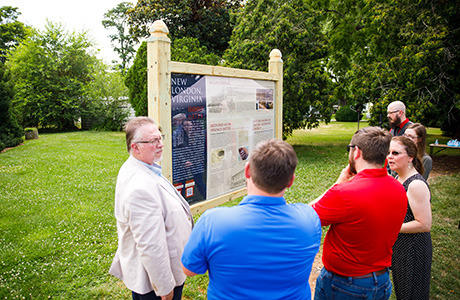
The New London projects give students hands-on opportunities in archaeology, historical architecture, historical interpretation, and much more.
- 250th Commemorative Conference
In honor of the 250th anniversary of the founding of the United States, the Department of History invites scholars, students, and researchers to participate in our commemorative conference, America’s Founding: Legacy and Influence. Join us as we reflect on the story of a nation and the faith, courage, and convictions that continue to shape it. Liberty University is proud to be a Commemorative Partner of VA250—Virginia’s American Revolution 250 Commission.

Start Your Journey as a Student at Liberty
What Our Alumni Say:
Fill out our Alumni Survey
Many of you may be familiar with this bright yellow flag, but did you know the Gadsden Flag dates to the American Revolution? It was designed in 1775 by Christopher Gadsden of Charleston, South Carolina. It features a yellow background with a coiling timber rattlesnake on green grass with the words "Don`t Tread On Me" underneath it. The rattlesnake was a symbol of unity of the thirteen colonies at the beginning of the Revolutionary War and was also used as a political symbol in the colonial era. The flag itself was used as a physical symbol of the Revolution`s ideals. The flag was also used by Commodore Esek Hopkins and was used on the mainmast of his flagship USS Alfred. Hopkins was later made Commander-in-Chief of the Continental Navy and adopted the Gadsden flag as his personal flag, and it was also used early in the war by the Continental Marines. The flag today is often associated with far-right libertarianism, but it still stands out in American history because of its symbolism of fighting tyranny and the ideals of the American founding.
Courtesy of Schuyler Ogden, History PhD, Liberty University
Jun 8


As we approach this country’s 250th birthday, we can reflect on the numerous events that have made our nation what it is today. We commemorate these kinds of events by separating certain days and places in remembrance. For example, in December 2023, Bedford was recognized as Virginia’s only World War II Heritage City, a distinction that honors the extraordinary sacrifices of this small community. During the war, men from Bedford served in every branch of the military and fought in many of its most significant battles. On D-Day, soldiers from the 116th Regiment, 29th Division — remembered as the Bedford Boys — stormed Omaha Beach, where the town suffered one of the highest per capita losses of any community in the United States. Twenty men from Bedford were killed on that day, and a total of 110 lost their lives over the 20course of the war.
Today, Bedford is one of just thirty-eight World War II Heritage Cities in the nation and continues to preserve its history through sites such as Centertown Plaza, Liberty Station, and the County Courthouse. It is also home to the National D-Day Memorial, one of the most striking and meaningful memorials on the East Coast, ensuring that the legacy of sacrifice and service endures for generations to come.
Jun 1

Do you know the history behind Memorial Day?
The location of the first Memorial Day is contested. In the years following the Civil War, there were similar yet independent movements across America to lay flowers on Confederate and Union graves alike.
Wherever these ceremonies were held, they were all united by a single number: 600,000. That number is the low estimate of U.S. Civil War deaths. That number was 2% of the U.S. population at the time, which today would number nearly 7 million.
That number caused a yearning to remember the fallen ever since. Towns across America continued to observe the holiday on May 30 through the 20th century, and, in 1971, it became a federal holiday observed on the last Monday in May.
Photos:
Memorial Day, May 30th, New York: Federal Art Project, 1936 or 1937. From the Library of Congress.
Honor the brave, Memorial Day, May 30, 1917. From the Library of Congress.
Memorial Day exercises in the new memorial amphitheater, Arlington National Cemetery, Va., 1928. From the Library of Congress.
Celebration of the fifth Decoration Day at Arlington Cemetery, May 30, 1873. From the Library of Congress.
#memorialday #remember
May 25


Contact
(434) 592-4366
history@liberty.edu
DeMoss Hall 4334
Connect

